The Russian space observatory "Spektr-M" will be able to observe supermassive black holes about 10 times more accurately than is currently possible. Moreover, the telescope should help to obtain images of several black holes in other galaxies that are not yet available for direct observation. Vyacheslav Avdeev, a researcher at the Astro Space Center of the P. N. Lebedev Physical Institute of the Russian Academy of Sciences, revealed the details.
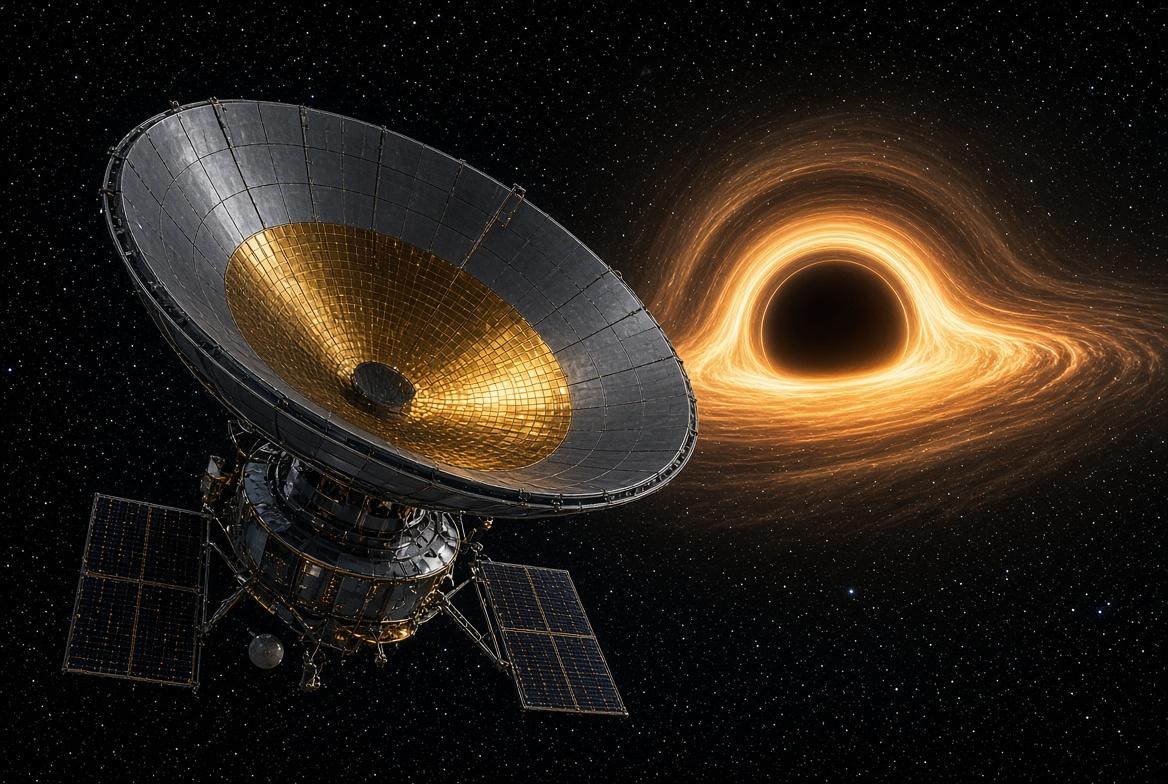
First of all, we are talking about supermassive black holes in the center of the Milky Way and the M87 galaxy. According to the scientist, an instrument like "Millimetron" will significantly improve the quality of observations of already known objects – by about 10 times – and expand the list of black holes that can be studied in this way.
The first image of a supermassive black hole in the M87 galaxy was obtained by the Event Horizon Telescope in 2019. In the same year, the shadow of a black hole in the center of the Milky Way was obtained.
However, the Event Horizon Telescope is not a single device, but a global network of radio telescopes. They are located at different points on Earth and operate as a single system.
Black holes can also be found indirectly – for example, by observing the movement of objects in binary systems. In this case, it may seem that a star is orbiting an invisible compact object. Direct detection of black holes is also possible, but this is a relatively new and rare way to study them, Avdeev noted.
The launch of the "Spektr-M" space observatory is planned for 2035. It is designed to observe deep space objects in the millimeter and infrared ranges.
The data obtained should help scientists better understand the origin, structure, and evolution of the Universe. The space telescope for the observatory will be created by Roscosmos enterprise "Reshetnev". Scientists also note that no country in the world will have analogues to the Russian project in the coming years.
Read more on the topic:
Never miss our newsAdd this site to your preferred sources to see us more oftenAdd on Google

















