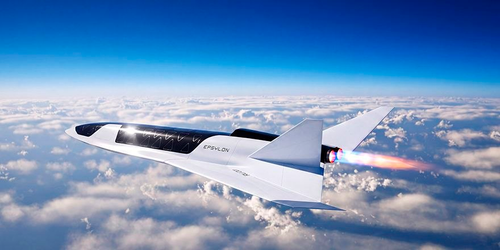
The Russian supersonic business jet concept EPSYLON shows what civil supersonic flight could be like after more than two decades of hiatus. While there is currently no operational commercial supersonic passenger aircraft in the world, the project proposes not just to bring back speed, but to completely rethink the space on board.
Supersonic passenger aviation virtually disappeared after the Concorde retired in 2003, and the Tu-144 ceased regular operations back in 1978. Today, several companies and scientific organizations are trying to bring back supersonic flight, but most projects focus on aerodynamics, engines, reducing sonic boom, and flight economics. EPSYLON stands out by detailing the cabin architecture.
The project is designed for a fuselage approximately 6.2 m wide, 5.4 m high, and a cabin length of 25.8 m – dimensions comparable to large business jets. The space is proposed to be reconfigured during flight: seats rotate 360 degrees and move along mounts, partitions on floor rails allow changing the cabin configuration, and separate zones are allocated for negotiations, relaxation, and clothing storage.

The wing also features an unusual solution. EPSYLON brings back the variable-sweep wing design, which the aviation industry largely abandoned in the 1980s and 1990s due to weight, complexity of the pivot mechanism, and cost. In the concept, the straight position is used for takeoff and landing, while at supersonic cruise speed, the wing adopts a high sweep angle.
Another compromise concerns the windows. Instead of completely eliminating portholes, as in some foreign projects, EPSYLON uses small triangular windows in combination with adaptive panoramic screens on the walls and ceiling.
The concept was developed by designer Philipp Avakyan from the St. Petersburg agency Asgard as part of a master's project; Mikhail Lebedev from BSTU "Voenmeh" acted as a scientific consultant for the aerodynamic part.
Read more on the topic:
Never miss our newsAdd this site to your preferred sources to see us more oftenAdd on Google