Researchers from the Institute of Microstructure Physics of the Russian Academy of Sciences (IPM RAS) and Nizhny Novgorod State Technical University named after R.E. Alekseev (NGTU) have developed new highly sensitive sensors for radio astronomy tasks and obtained a patent for the device. As explained by the developers, the instruments are designed to study the early stages of the Universe's evolution, register neutrinos, and search for axions – hypothetical particles that may form the basis of dark matter.
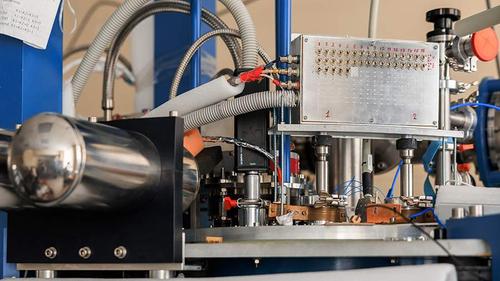
The device is an electromagnetic radiation receiver. When radiation hits the sensitive element, the temperature of the electrons increases, which changes the registered signal. The key task is to minimize heat leakage, as useful signal is lost along with it. This was achieved by adding a thin layer of hafnium, which acts as a thermal barrier, slowing down the transfer of electron energy to the environment and reducing parasitic currents.
According to Andrey Pankratov, leading researcher at IPM RAS and NGTU, axions hardly interact with matter, but under the influence of a strong magnetic field, they can turn into photons, which the device registers. If scientists can control this process, the energy of dark matter conversion into electromagnetic radiation could be converted into electrical energy.
The development was carried out with the support of the Russian Science Foundation. In the future, the technology could form the basis of new generation detectors for fundamental physics and astrophysics. The developed sensors can also be adapted to create devices using the principles of quantum metrology.
Read more on the topic:
- The Invisible Will Become Visible: The First Dark Matter Search Facility Will Be Created in Russia
- Research on Dark Matter, a Key Component of the Universe, Begins at MEPhI
- MEPhI gamma-ray telescope prototype to distinguish dark matter from interference: picosecond protection surpasses American "Fermi"
Never miss our newsAdd this site to your preferred sources to see us more oftenAdd on Google