Translated with AI from the Russian original.
Russian physicists from the Institute for Nuclear Research of the Russian Academy of Sciences intend to launch an experimental facility to search for dark matter particles before 2030. This was announced by Petr Satunin, a senior researcher at the institute. According to modern estimates, dark matter accounts for about 75% of the total mass of matter in the Universe, but its particles have not yet been discovered.
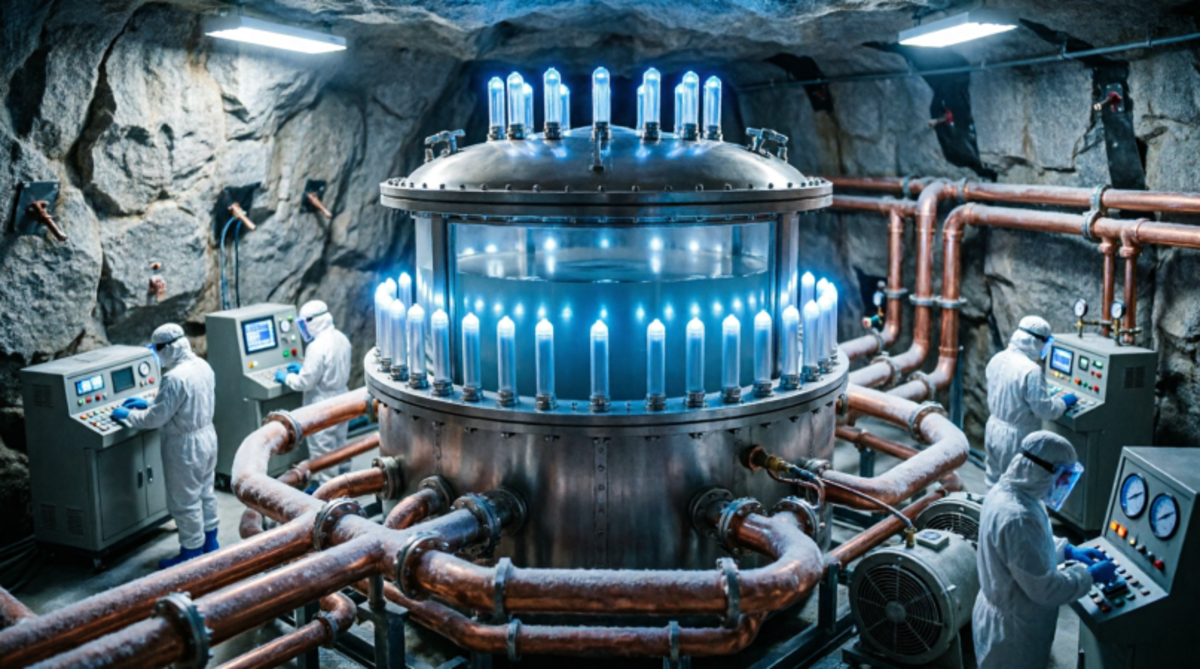
The future facility will be based on single-photon counters. Devices created taking into account the effects of macroscopic quantum tunneling have an extremely low false positive rate. This will allow measurements to be carried out with high accuracy and to record rare events of conversion of hypothetical dark matter particles into photons.
The facility will include a dilution refrigerator to maintain ultra-low temperatures, a compact resonator with a diameter of about two centimeters and a length of ten centimeters, and a powerful magnet. A prototype of the resonator has already been created, and a full-fledged launch of the complex may take place in the next two years.
Scientists are betting on axions — light hypothetical particles that are considered one of the most promising candidates for the role of dark matter constituents. According to the theory, when passing through a magnetic field, an axion can turn into a photon with a low probability. It is these events that the new facility will register.
Read more on the topic:
Never miss our newsAdd this site to your preferred sources to see us more oftenAdd on Google

















