Translated with AI from the Russian original.
The All-Russian Scientific Research Institute of Aviation Materials of the Kurchatov Institute has received a patent for a new heat-resistant alloy for aircraft engines and gas pumping units. The material is intended for parts operating at extremely high temperatures and loads.
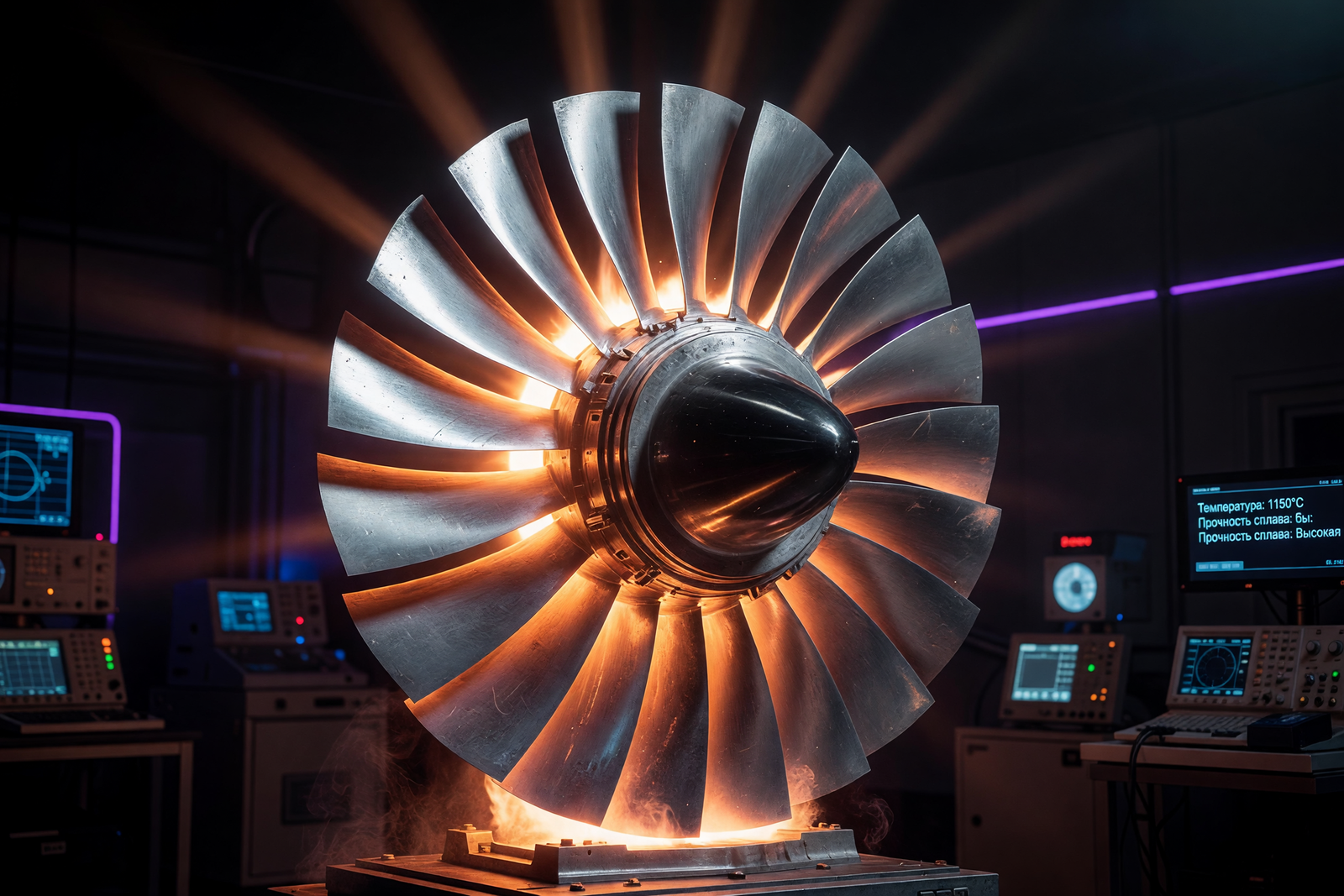
The development belongs to the class of intermetallic alloys based on nickel and aluminum. This is one of the most promising materials for aircraft engine manufacturing: it has a high melting point, low density, and retains its properties even when strongly heated.
The new alloy withstands prolonged exposure to temperatures up to 1150°C and is resistant to cyclic loads at 850 and 1050°C. It also maintains compressive strength in the temperature range from 850 to 1200°C. Such characteristics allow it to be used for the production of gas turbine engine blades, parts of high-temperature machines, and threaded connections operating in extreme conditions.
The key advantage of the alloy is its ability to maintain strength when heated, which is especially important for new generation aircraft engines. The Kurchatov Institute conducts research within the framework of comprehensive programs for the development of technologies for aircraft engine manufacturing.
The topic of high-temperature alloys for aviation turbines is being developed simultaneously in several Russian scientific centers. Heat-resistant blades for the PD-8 engine were created at ODK-Saturn and VIAM; a refractory alloy based on niobium, molybdenum, tantalum, and vanadium was developed at SPbGMTU and Skoltech and retains 60% strength at 1000°C. The Kurchatov Institute's alloy is designed for long-term operation up to 1150°C — the range in which new generation gas turbine engine blades operate.
Read more on the topic:
Never miss our newsAdd this site to your preferred sources to see us more oftenAdd on Google

















