Translated with AI from the Russian original.
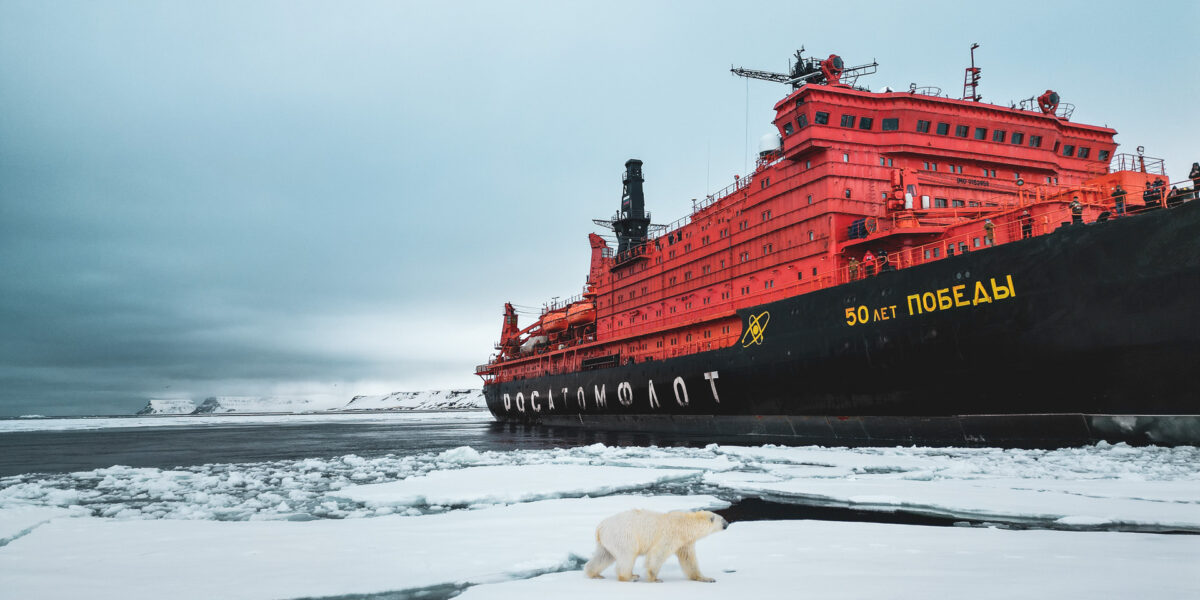
The crew of the nuclear icebreaker "50 Years of Victory," under the command of Captain Andrey Gorban, discovered five significant depth changes in the waters of the East Siberian, Laptev, Barents, and Kara Seas. The discoveries were made during regular vessel transits along the Northern Sea Route.
The data obtained has been sent to eliminate "blank spots" on navigational charts, as approximately 80% of the routes in the East Siberian Sea still lack detailed bottom relief mapping. The research helps improve navigation safety in the region and expand access to new routes.
Underwater elevations were identified in two ways: by stamukhas—stable hummocky ice floes sitting on shoals—and by sharp changes in echo sounder readings. The first two banks, with depths of 15 and 8.2 meters, were discovered fifteen years ago, and the subsequent three points (17.3, 40, and 46 meters) were recorded later. According to the current classification, these objects are classified as distinctive depths and do not pose a direct threat to navigation, but mapping them is critical for the safety of Arctic voyages.
In Russia, information about new underwater objects is transferred to the Navigation and Oceanography Department of the Navy. After verification by hydrographers, an official notice to mariners is issued, and the discoverer can suggest a name for the object.
Timely updating of charts reduces the risk of vessels running aground, especially in conditions where standard echo sounding equipment only "sees" the depth directly under the keel. For the technical fleet and logistics companies, this means increased route predictability and reduced insurance costs when developing Arctic routes.
"50 Years of Victory" is a Russian nuclear icebreaker of Project 10521. It was built at the Baltic Shipyard in Leningrad (later St. Petersburg). It was laid down on October 4, 1989, under the name "Ural" and launched on December 29, 1993. It was put into operation on March 23, 2007.
Read more on the topic:
Never miss our newsAdd this site to your preferred sources to see us more oftenAdd on Google

















