Translated with AI from the Russian original.
A hydrogen Aurus was presented at the "INNOPROM. Belarus" exhibition, which became the most powerful car in its class. The hydrogen-powered Aurus Senat received a different name: NAMI Hydrogen. It is the first "luxury" car in the world powered by hydrogen fuel cells.
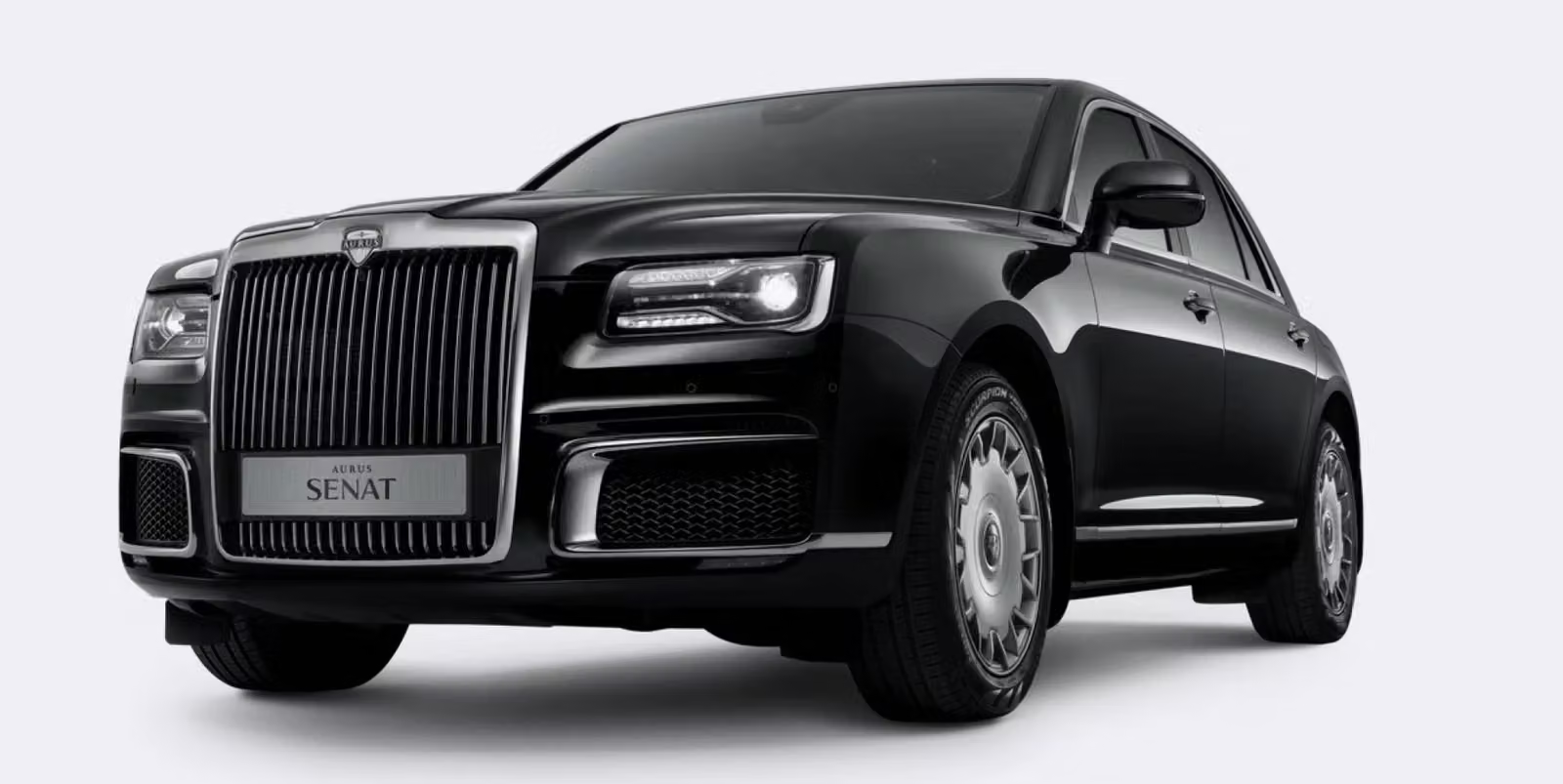
Electricity to charge the battery is generated by the reaction of oxygen and hydrogen, in which hydrogen releases electrons that interact with oxygen to produce energy. As a result of this process, only steam is released into the atmosphere, making the car environmentally friendly.
There are several models in the world that also run on fuel cells, but they are ordinary mass-market segment, and this is a "luxury" class.
The car presented in Minsk is a prototype. The main driving forces in it are electric motors. Two electric motors are located on the rear axle, and one on the front.
This is our fourth prototype. What is its task - it is the development of NAMI's competencies and the Russian automotive industry as a whole.
To launch the car into production, it is necessary to refine the legislation of the Russian Federation and establish an infrastructure for hydrogen refueling stations.
The driving range of the presented prototype using a backup battery is about 600 km, and the maximum speed reaches 240 km/h.
The car is equipped with all-wheel drive, a hydrogen electrochemical generator with a capacity of 110 kW, a battery capacity of 100 kW·h, and the total power of the three electric motors is 750 kW, which is equivalent to 1020 horsepower.
Read more on the topic:
- Aurus has become more powerful: it now has 636 horsepower
- Aurus is preparing budget car models; the manufacturer is restructuring the model range
- Aurus Komendant in an unusual color noticed in Moscow
Never miss our newsAdd this site to your preferred sources to see us more oftenAdd on Google

















