Translated with AI from the Russian original.
Ten years ago, the first flight of the new Tu-214SR with serial number 027, built at the Kazan Aviation Plant (KAZ) named after S.P. Gorbunov (part of PJSC Tupolev), took place.
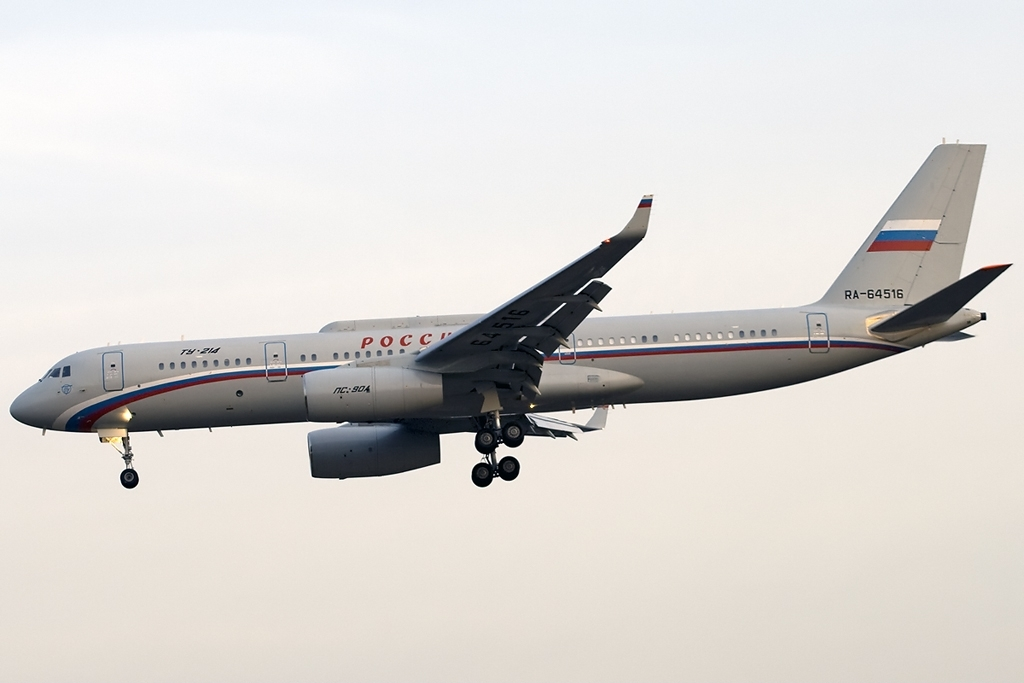
“Machine 027” was manufactured under a contract signed in October 2012 for the construction of three Tu-214SRs. This was already the second aircraft. The third was then under construction.
The Tu-214SR relay aircraft was developed for the administration of the Russian president. Its main purpose is to provide the head of state with uninterrupted communication.
Currently, the Special Flight Detachment "Russia" has five Tu-214SRs in its fleet. According to experts, the highlight of the machine is that it is capable of performing the functions of a huge moving Wi-Fi router.
Special machine for special tasks
The new Tu-214SRs replaced the relay aircraft based on the Il-18, which had been operated in the special detachment for more than 40 years.
Tu-214SR is a modification of the long-range Tu-214. The base machine was chosen for a reason: in the passenger version, its main flight, technical and economic characteristics correspond to the Airbus A-320 and Boeing 757.
Unlike the “base”, the Tu-214SR is equipped with additional fuel tanks that increase the flight range from 7 to 10 thousand kilometers, as well as power supply systems and a radio engineering complex.
Externally, the Tu-214SR stands out due to the presence of antenna fairings in the upper part of the fuselage. The aircraft can carry 72 people on board.
Relay aircraft on the plane will allow you to create a temporary or permanent data transmission network where traditional communication infrastructure is simply absent or insufficient.
Ready to work anytime, anywhere
Flying repeaters can be prepared for operation at the right time and in the right place. For example, during emergency tasks or operational-tactical exercises.
Encrypted information travels in short pulses, at different frequencies and with high quality. It is difficult to intercept and establish the points of departure and reception. Such a system is not cheap, but, as they write, it provides the highest possible security requirements.
And another key point: there has never been a single imported part on the Tu-214 for the Special Flight Detachment. Avionics, tracking systems, inertial systems, navigation - everything is purely Russian.
Earlier www1.ru reported that a new wide-body aircraft will appear in Russia: the development deadlines have been announced.
Read more materials:
“Thank you for your service”: the last An-22 “Antei” was written off for retirement
“50% is still a long way off”: will Russia be able to import half of its aircraft fleet with the help of MS-21 and SJ-100?
Workhorse: the deadliest Russian Flanker fighter in the Flanker line has been named
Never miss our newsAdd this site to your preferred sources to see us more oftenAdd on Google

















