Translated with AI from the Russian original.
At the St. Petersburg State University of Industrial Technologies and Design (SPbSUPTD), a unique fabric has been developed that generates electrical energy when heated. This innovation can be used in the thermal insulation of rocket bodies, and in the future, in wearable electronic devices that use human body heat. This was reported by the university's press service.
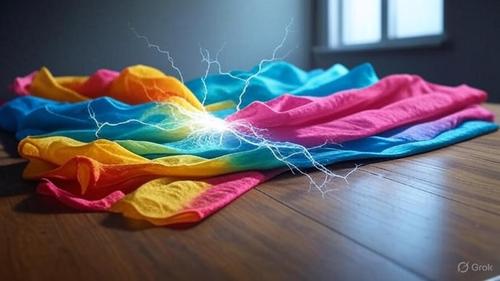
The fabric includes photosensitive threads made of modified carbon fiber. They are a chemically pure substance consisting of thin carbon threads with a diameter of 6 to 10 μm.
These threads have high resistance to atmospheric influences and chemical reagents, as well as a high modulus of elasticity and low density. In a vacuum, they can withstand temperatures up to 4,000 K without decomposing and have a very small coefficient of thermal linear expansion. This makes them indispensable in the field of electronics.
Modified carbon fiber has the property of generating electric current under the influence of electromagnetic wave radiation falling on it. The UV thread created in this way is a source of photo-EMF - photoelectromotive force.
An analogue of this development is a foreign fabric that converts electromagnetic radiation into electricity in the visible spectrum. However, fabric made of modified carbon fiber has an advantage - it has photosensitivity in the infrared range, reacting to heat. This expands its scope.
Earlier,www1.ru reported that fabric with a cooling effect wascreated by scientists at BFU.
Read materials on the topic:
Scientists at MTUCI have developed a method for automatic rejection of fabrics
Say "no" to washing: Novosibirsk scientists have invented a self-cleaning fabric
In Russia, a technology for 3D printing human tissue from living cells has been developed
Never miss our newsAdd this site to your preferred sources to see us more oftenAdd on Google

















