The assembly of the Soyuz-2.1b carrier rocket for launching the Resource-P No. 5 Earth remote sensing satellite has been completed at the Baikonur Cosmodrome.
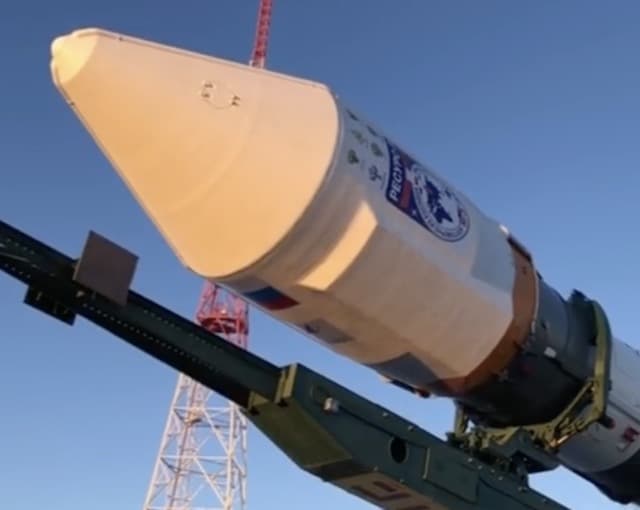
This morning, December 23, the rocket was successfully transported to the launch site and installed in a vertical position. Baikonur employees met the rocket at dawn, watching it being installed on the launch pad.
The rocket launch is scheduled for December 25 at 10:45 Moscow time. The broadcast of the event can be viewed on the Roscosmos website.
The Soyuz-2.1b carrier rocket and the Resource-P No. 5 satellite, developed and manufactured by the Rocket and Space Center Progress (part of Roscosmos), are being prepared for launch with an important mission. The Resource-P No. 5 satellite is designed for high-detail, detailed wide-swath, and hyperspectral optoelectronic Earth observation.
The Soyuz-2.1b carrier rocket features images dedicated to significant dates and events: the Republic of Sakha (Yakutia), the 390th anniversary of the Yakut city of Vilyuisk, the 1015th anniversary of the city of Yaroslavl, as well as the 2000th launch of the R-7 family of rockets.
Earlier, www1.ru reported that the Soyuz rocket for launching Resource-P No. 5 was assembled at Baikonur.
Read more on the topic:
Don't forget the trash! How Russian cosmonauts recycle old equipment and ISS waste
Russian space security system "Milky Way": what is known about it
Russian phantoms "Matryoshka-R" measured radiation in the organs of cosmonauts
Now on home

Start of deliveries scheduled for 2027

Over 51,000 new motorcycles were sold in Russia in 2025

The car will take at least a year to assemble

The application's audience has reached 20 million users

The model will be included in the list of cars for taxis, price - from 2.25 million rubles

All parking lots of the "Administrator of the Moscow Parking Space" are connected to the service

The cars will be supplied to the Moscow Transport Service Directorate
Deliveries to India may begin in 2028

The technology provides automated search for all types of defects in power units

The plane flew 500 km, accelerating to 425 km/h

The plant stated that the information about the termination of purchases for models 6 and 8 is not true
Scientists are using the "Ekran-M" installation