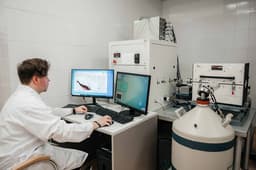
Specialists from Tomsk Polytechnic University (TPU) conducted a study of the spectra of gaseous silane and deuterated methane molecules in certain areas of the infrared spectrum with much higher accuracy than was previously possible. The results obtained can be useful for studying the atmospheres of gas giant planets and their satellites, such as Jupiter, Saturn and Titan, in the framework of planetology.

The Ministry of Science and Higher Education of Russia emphasized that methane and silane are among the most common elements in the Universe. They are present in the atmospheres and on the surfaces of giant planets located on the periphery of the Solar System, as well as in some nebulae.
However, at the moment, technology does not allow humans to reach such distant corners of space to see and record what is happening there.
Physicists have databases of spectral lines. And the results we obtained will replenish these databases. With them, any task of astrophysics or planetology becomes feasible.
In order to understand what is happening in the atmosphere of Titan, an interplanetary station is used, which takes spectral images and transmits them to scientists. Then, specialists compare this data with what is already available in the databases. After that, using various calculations, they can determine, for example, what the temperature is on Titan and how it changes.
The more detailed researchers analyze the spectra of various molecules, the more accurate information they can obtain about objects located in remote corners of space.
Spectroscopy allows you to study the spectra of electromagnetic radiation that occur during transitions between energy levels in atoms and molecules. Based on these data, it is possible to make an assumption about what is happening in the microcosm.
Titan is not a planet, but a celestial body consisting of water ice and organic matter, with a dense atmosphere. Titan is the largest satellite of Saturn, and in the Solar System it is second only to Ganymede, the satellite of Jupiter, in size.
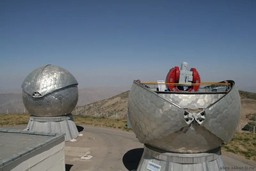
Earlier, astrophysicists from Kazan Federal University made another significant discovery, discovering four new cataclysmic variables — these are binary star systems, including a white dwarf and a less massive satellite star. Scientists conducted observations using the largest optical telescopes in the world.
Read materials on the topic:
Crimean amateur astronomer discovers a new comet in the Solar System
Not time to retire: the Spektr-RG observatory will operate longer than the warranty period