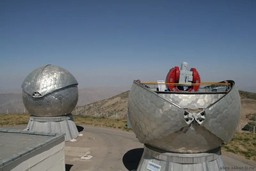
The Russian Astro Space Center (ASC FIAN) intends to build a new generation of observatories. They will include ground-based antenna arrays, a space interferometer, and a telescope to be placed on the Moon.

The antenna arrays will consist of six antennas with a diameter of five meters. They represent a set of antennas working together as a single unit to transmit or receive radio waves. The antennas can be directed in different directions, covering large areas, and then combine the data obtained into a single picture. Their test will take place at the Pushchino Radio Astronomy Observatory.
The scientists plan to create a sub-terahertz observatory. Sub-terahertz devices operate at frequencies from 100 GHz and above, similar to infrared or microwave rays. In the observatory, astrophysicists will be able to explore space.
The next development will be a space interferometer — a device capable of measuring the sizes of stars, the distances between them, and their luminosity. This device should be located in space, it will be able to explore space at a distance of about 1.5 million kilometers. Based on the collected data, a high-resolution image will be formed. The device will be able to create images with which you can observe black holes and stars, recording changes in their state.
The most interesting project will be the lunar observatory. This promising development will give scientists the opportunity to work in previously inaccessible ranges of the electromagnetic spectrum. Due to the ionosphere, man-made noise, and the Earth's atmosphere, it is difficult to study space, but placing telescopes on the Moon will help solve many of these problems. However, first it is necessary to build such an installation.
Read more on the topic:
Russian scientists are testing equipment for sending mice into space
Crimean scientists have discovered more than 750 asteroids using a Soviet telescope
Astrophysicists in Kazan have discovered four new star systems