Russian "Gerbera" drones are not capable of imitating strategic Kh-101 and tactical Kh-69 cruise missiles for enemy air defense systems, but they are effective due to their low cost. This was stated by military expert Evgeny Damantsev.
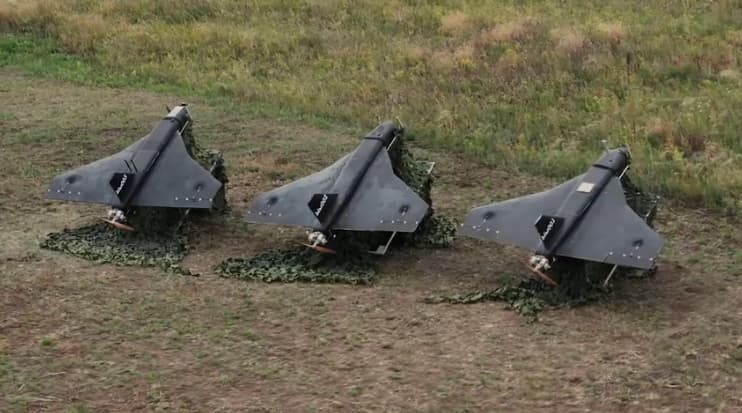
According to him, the mass-dimensional parameters, combined with the widespread use of composite materials in the architecture of gliders, provide the products with an effective reflecting surface of about 0.03 - 0.01 m², minimizing the detection range by means of detection radars and TRML-4D target designation of IRIS-T SLM complexes to 17 - 15 km.
In addition, the detection range of the "Gerbera" by German radar guidance systems of the "Skynex" anti-aircraft artillery systems, equipped with AHEAD programmable ammunition, is significantly reduced in difficult meteorological conditions.
Nevertheless, "Gerbera" drones are not capable of imitating strategic Kh-101 and tactical Kh-69 cruise missiles, since their flight speed is limited to 220 - 250 km/h, while the speed of the above-mentioned missiles varies in the range from 0.65 to 0.95M.
Earlier www1.ru reported that the Russian army reduced the losses of Supercam reconnaissance drones to almost zero. UAV operators know in advance where the enemy's air defense and electronic warfare points are located.
Read related materials:
Now on home

The service contains data on 45,000 fraudulent sites

The state has accelerated the introduction of unmanned solutions, integrating them into the real sector of the economy

Modernized engines may equip the Lada Azimut crossover

The price is 132 billion 265.8 million rubles

The manufacturer plans to strengthen its lineup of light commercial vehicles

The production of carbon fiber was organized in the shortest possible time

Electric vans will speed up the repair of urban transport infrastructure

Countries are working to synchronize regulations in the field of AI

The service's average daily audience is 55 million people

Stable Isomaterial Based on Metakaolin Has a Density Below 300 kg/m³

Re-identification quality improved twofold with new DynaMix method

Russians will be able to find out about debts online