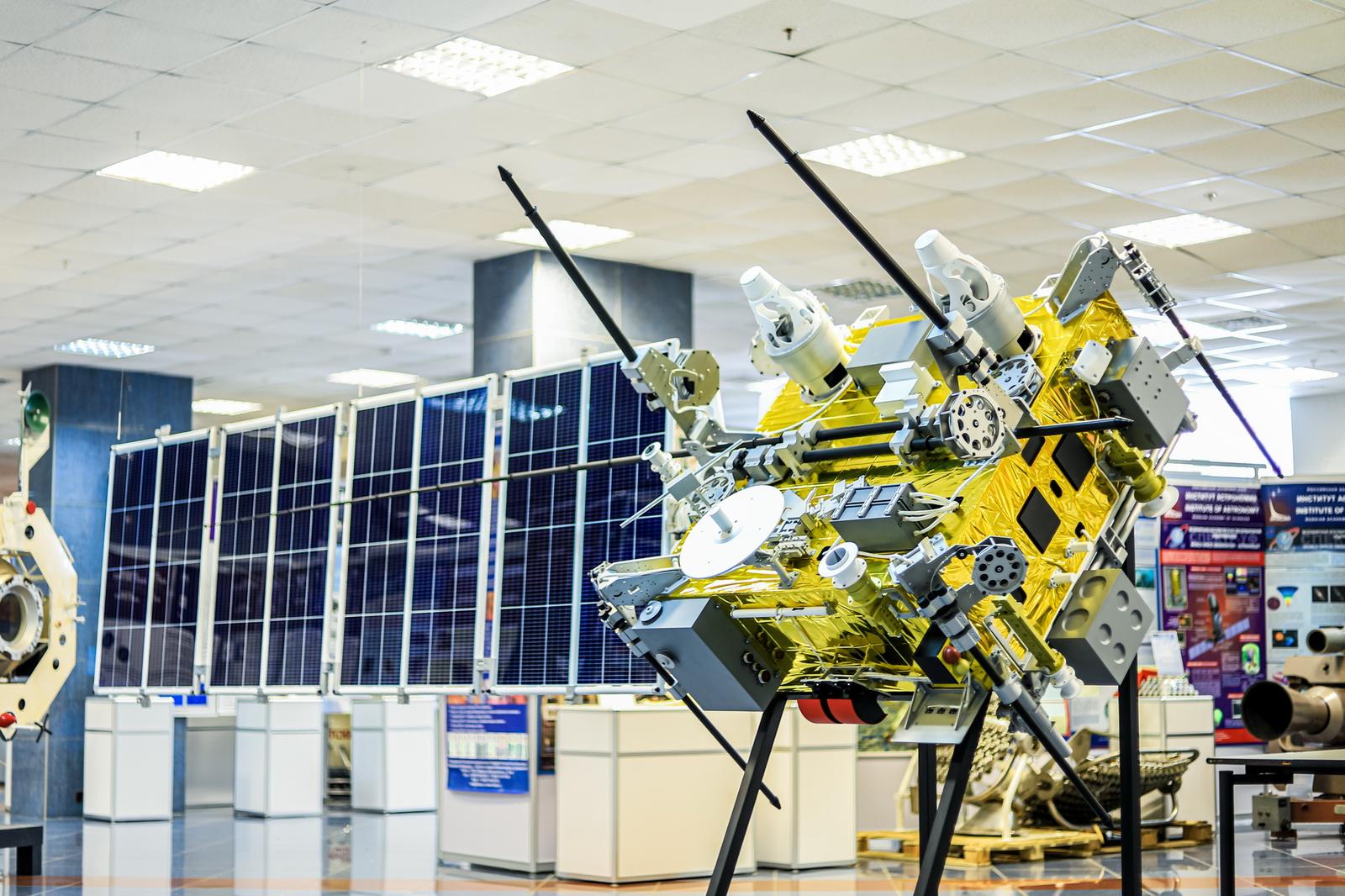
Roscosmos announced the return to Vostochny for active preparation for the launch of the spacecraft "Ionosphere-M" No. 1 and No. 2 of the "Ionosond" project. Specialists from the Vostochny Space Center and NPO Lavochkin are conducting electrical tests of the Fregat upper stage. It is used to launch these satellites and related payloads, but the launch date has not yet been announced.
After completion of the checks, the Fregat will be transported to the refueling and neutralization station for refueling with fuel components and compressed gases.
"Ionosond"
"Ionosond" is the first Russian new space complex for monitoring the geophysical environment or "space weather". "Ionosond" will be the first element of the Russian space weather monitoring system. Its customers are Roshydromet and the Russian Academy of Sciences, and the scientific load of the project is handled by the Space Research Institute of the Russian Academy of Sciences (IKI RAS) and the E.K. Fedorov Institute of Applied Geophysics of Roshydromet.
"Ionosond" will include four "Ionosphere-M" spacecraft, two spacecraft in two orbital planes. Each spacecraft of the group, which is assembled by VNIIEM (part of the Roscosmos State Corporation), will operate ionosondes among the scientific instruments. They emit radio pulses at different frequencies and can perform "tomography" of the ionosphere, studying the concentration of electrons at different heights from the surface.
The study of the ionosphere is important not only for fundamental research, but also for monitoring "space weather". The ionosphere is a special shell of the Earth that appears when neutral particles in the upper atmosphere absorb X-ray and ultraviolet radiation, ionize and turn into ions and electrons. At different heights, the concentration of charged particles is different, and it changes depending on many space factors - solar activity, galactic cosmic rays, and others. Therefore, knowing the state of the ionosphere, we can understand what the "space weather" will be in the near future.
The launch of the first pair of satellites was planned for the end of 2022 or the beginning of 2023, but is happening with some delay.
Read materials on the topic:
It became known what "RESHETNEV" will show at the first Egypt International Airshow
Fourfold coverage of Russia, one hundred neural networks: what the "Digital Earth" project does
Reshetnevtsy are preparing to import-substitute adjusting screws with a thread pitch of 0.25 mm
Elon Musk said that Russia could help return astronauts stuck on the ISS to Earth
Never miss our newsAdd this site to your preferred sources to see us more oftenAdd on Google

















