Material updated on 14.02.2024 at 15:50
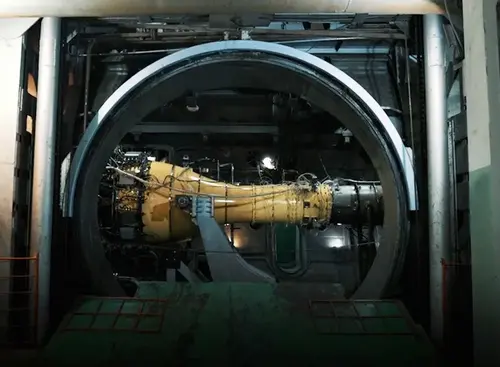
The Russian promising PD-35 ultra-high thrust aircraft engine has received a new element - the STG-PD-35 starter-generator. It has already been tested at the P. I. Baranov Central Institute of Aviation Motor Development (CIAM) and at the new laboratory stand of the Advanced Engineering School "Engines of the Future" at the Ufa University of Science and Technology.
Updated:
The new unit will increase electrical power several times over while reducing the specific weight, and for an aircraft, weight is a critical parameter. The essence of the project is that the aircraft uses a large proportion of mechanisms, systems, and units that run on electric traction. In a modern aircraft, more than 30% of the power plant's efficiency is spent on taxiing on the runway, filtering, and cooling air for supply to the cabin and cockpit. These auxiliary functions can be started with electricity, which will be much more economical and simpler.
The starter-generator, developed at the Advanced Engineering School "Engines of the Future", is an electrical machine and a control unit that is powered by the on-board network. The machine operates in start-up mode and until the gas turbine engine reaches full speed. In addition, thanks to a number of design solutions, for example, through the use of modern high-energy materials, maintenance will be significantly simplified and the service life of the aircraft will be increased.
The fifth-generation PD-35 engine, which has become the largest and most powerful in the history of Russian aviation, weighs about 8 tons. The project is long-term, work has been underway on it since 2016, but it has made significant progress in the last two years. By October 2023, the first tests of the gas generator were successfully carried out. And tests for the prototype of the "Tsar Engine" itself, according to the Rostec State Corporation, are scheduled for the beginning of 2024.
Never miss our newsAdd this site to your preferred sources to see us more oftenAdd on Google

















