Domodedovo customs officers found old aircraft clocks in a package from Israel, the level of ionizing radiation on their surface reached 2.75 µSv/h — approximately 20 times higher than the natural radiation background. The shipment was intended for a resident of Udmurtia, and the documents listed keys, a bag, a backpack, and clothes instead of clocks.
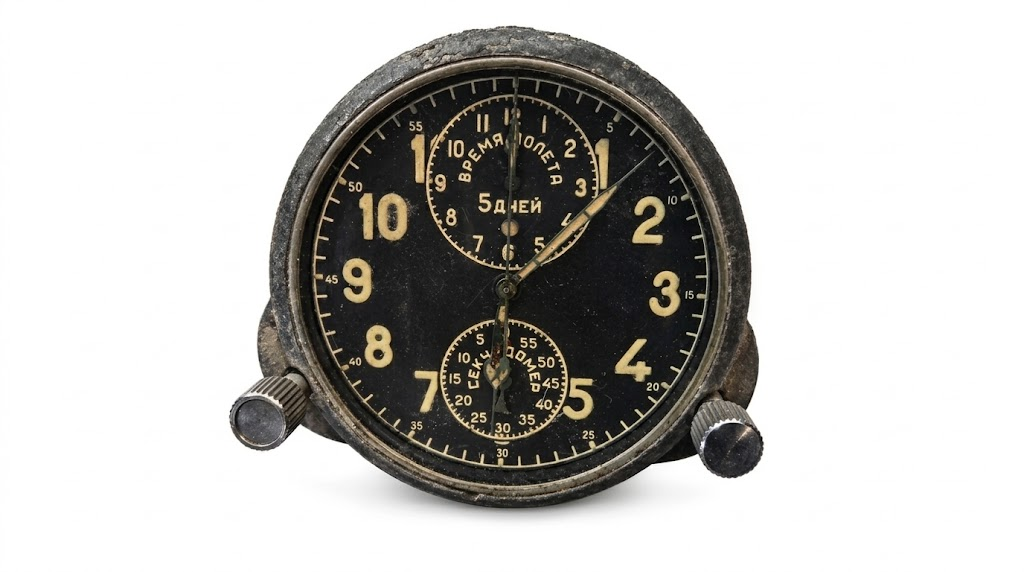
According to the photo provided by the customs press service, the device resembles the Soviet ACH aircraft chronograph. The black dial shows the inscriptions “FLIGHT TIME” and “5 DAYS”. The first indicates the scale for counting the duration of the flight, and the second indicates a five-day power reserve of the mechanism. This is an important difference from the later ACHS-1, which had the designation “2 DAYS” on early versions of the dial.
ACH type clocks were produced by the First Moscow Watch Factory. They belong to early Soviet onboard instruments, the production of which continued in the post-war years and in the first half of the 1960s. Presumably, these clocks could have been installed on Soviet aircraft of the first post-war generation — for example, MiG-15, MiG-17, MiG-19, or Su-7.
The indicator of 2.75 µSv/h characterizes the dose rate at the measurement point, not the amount of radiation already received by a person. If one were to hypothetically stay near the source continuously for 24 hours and receive such a dose rate all that time, the accumulated dose would be about 66 µSv. Over a year, under unchanged conditions, it would reach approximately 24 mSv. In reality, the result depends on the distance to the clocks, contact time, shielding, and the nature of the radiation.
Therefore, the detected value does not mean that brief contact with the clocks will necessarily lead to acute radiation injury. However, prolonged storage of a radioactive object near the body or in the workplace can create additional exposure. Customs recognized the clocks as dangerous for domestic use, and after sanitary and quarantine control, Rospotrebnadzor established their non-compliance with uniform sanitary requirements.
One possible cause of radiation is radioluminescent paint, which was previously used to coat the numbers and hands of instruments to keep them visible in the dark. Some old luminous compounds used radium-226. Its half-life is about 1600 years, so the radioactivity of such a coating can persist for a very long time.
Following the inspection, the import of the clocks into Russia was prohibited. The package must be returned to the sender in Israel.
Read more on the topic:
Never miss our newsAdd this site to your preferred sources to see us more oftenAdd on Google