Translated with AI from the Russian original.
Russian physicists have come closer to understanding why graphene oxide membranes selectively pass different substances. Scientists from the FRC of Chemical Physics named after N. N. Semenov of the Russian Academy of Sciences investigated the state and mobility of liquid molecules in the interlayer space of the material.
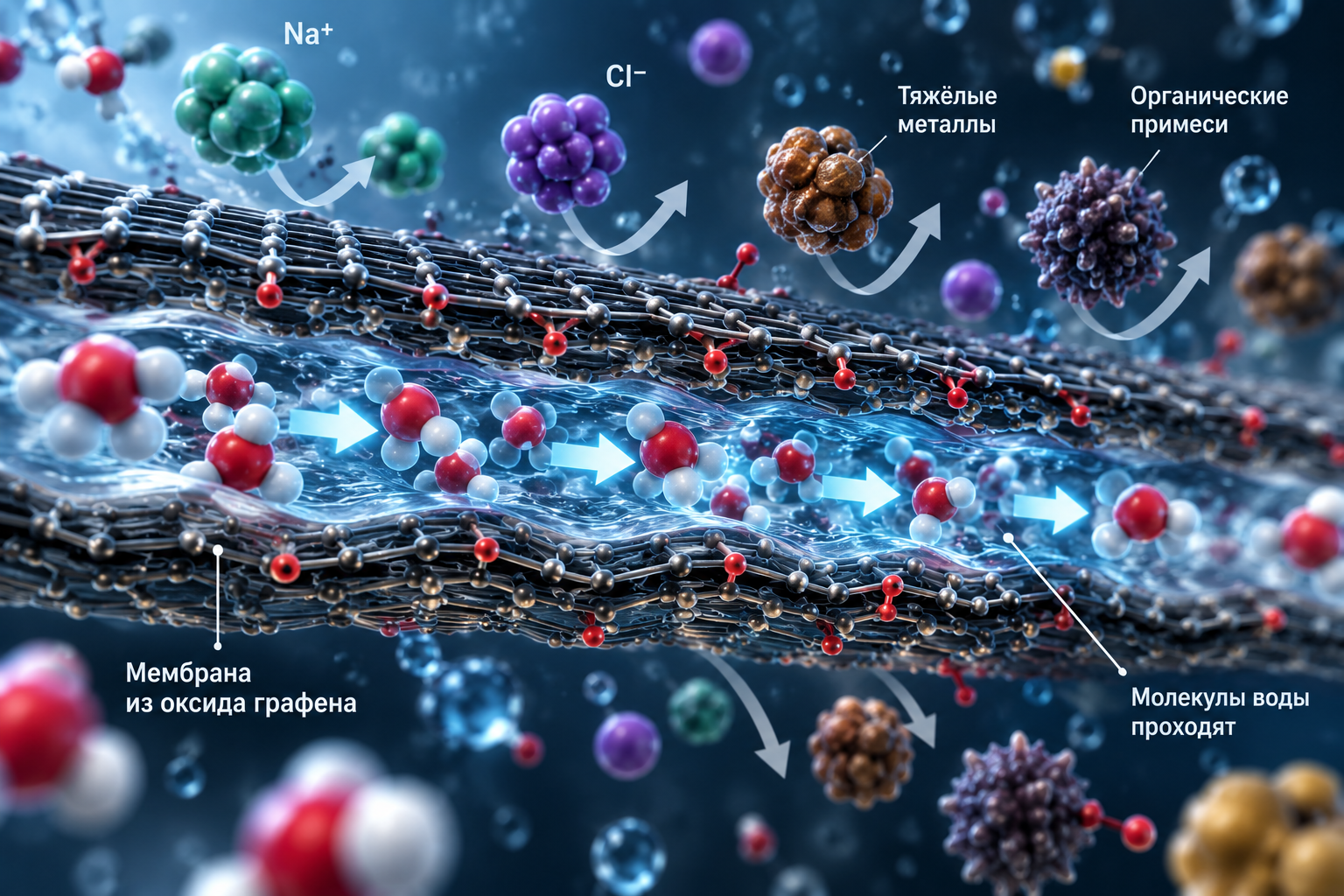
The researchers used the electron paramagnetic resonance (EPR) method to study the state of liquids in the interlayer space of graphene oxide membranes. It turned out that water molecules in the interlayer space of the membrane can have significantly lower mobility than in free liquid. The researchers attribute the differences in mobility to the peculiarities of the material's internal structure.
Now membranes can be manufactured with the necessary properties — like a building from a blueprint — instead of being chosen at random.
The discovery can help create filters for purifying water from impurities, salts, and heavy metals, separating complex liquids, and processing radioactive waste. In the future, the technology will allow for more precise control over membrane properties, rather than selecting them experimentally.
Read more on the topic:
Never miss our newsAdd this site to your preferred sources to see us more oftenAdd on Google

















