The Higher School of Economics has become a member of the international BESIII collaboration, which studies the properties of heavy subatomic particles and searches for "new physics" beyond the Standard Model.
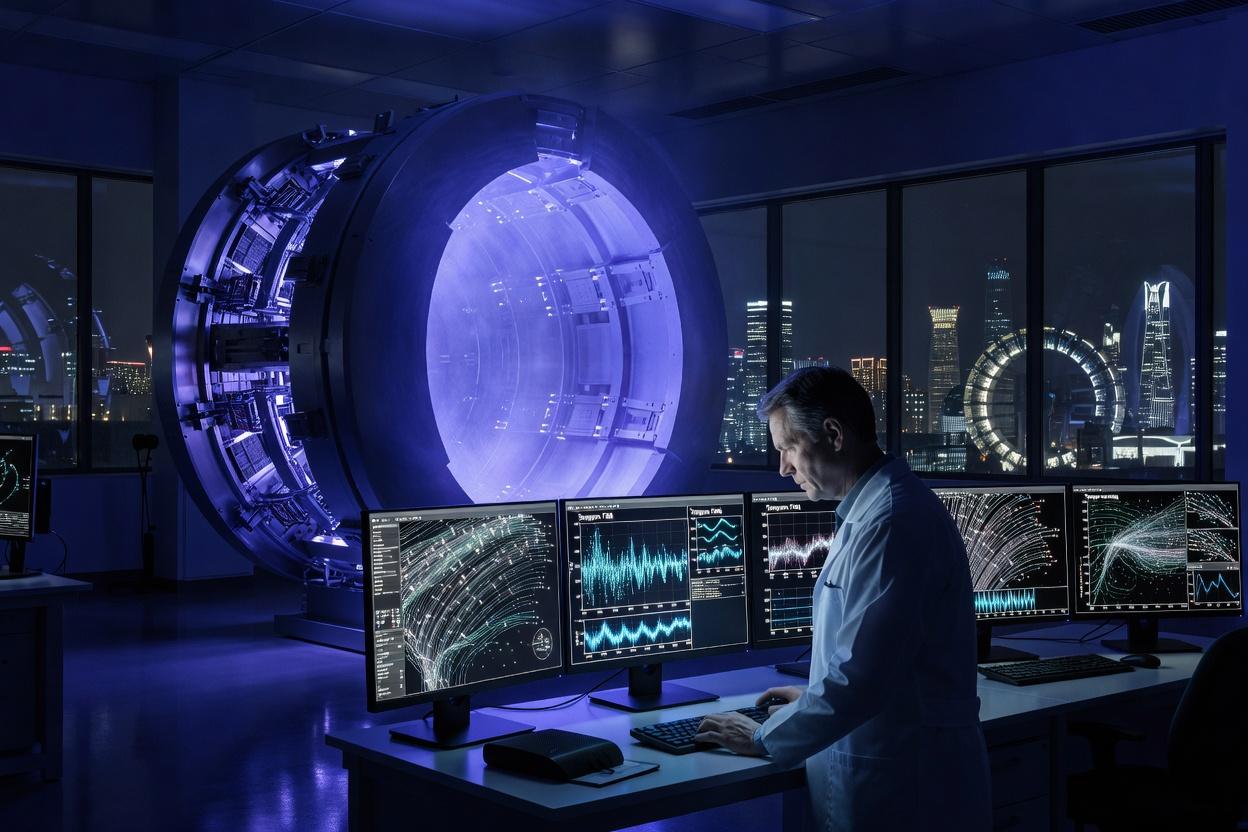
Joining the collaboration was the first practical result of a memorandum of cooperation signed in 2025 between HSE University and the Institute of High Energy Physics in Beijing.
What Russian physicists will be doing
A group of researchers from the International Laboratory of Elementary Particle Physics at MIEM HSE will focus on quantum-correlated production of charmed hadrons, studying the parameters of high excitations of strange and charmed particles.
The head of the laboratory, RAS Corresponding Member Tagir Aushev, explained that membership in the collaboration gives HSE scientists full access to BESIII experimental data and the opportunity to conduct independent physical analysis. According to him, this allows them to test their own scientific ideas with real data, search for new and rare processes, and verify theoretical predictions.
Participation also implies a contribution to the common work: scientists will perform service shifts at the detector, participate in the development of software and computational infrastructure. Postgraduate students and undergraduates will have the opportunity to work with advanced equipment.
What is BESIII
The BESIII experiment was launched in 2008 to study processes in the tau-charm energy range – from 2 to 5 GeV. The detector is installed on the electron-positron collider BEPCII at the Institute of High Energy Physics in Beijing.
The collaboration unites over 700 scientists and 86 scientific institutes from 16 countries. In August 2026, BESIII announced evidence for the existence of a glueball – a particle consisting only of gluons, which had been sought for almost half a century.
Read more on the topic:
Never miss our newsAdd this site to your preferred sources to see us more oftenAdd on Google