Translated with AI from the Russian original.
Russian scientists have conducted a series of experiments with samples of oil-bearing sandstones. Their results will help researchers select the optimal level of detail for digital models of deposits – one that allows for the most accurate and, at the same time, rapid assessment of the prospects for field development. Details were disclosed by the press service of the Russian Science Foundation (RSF).
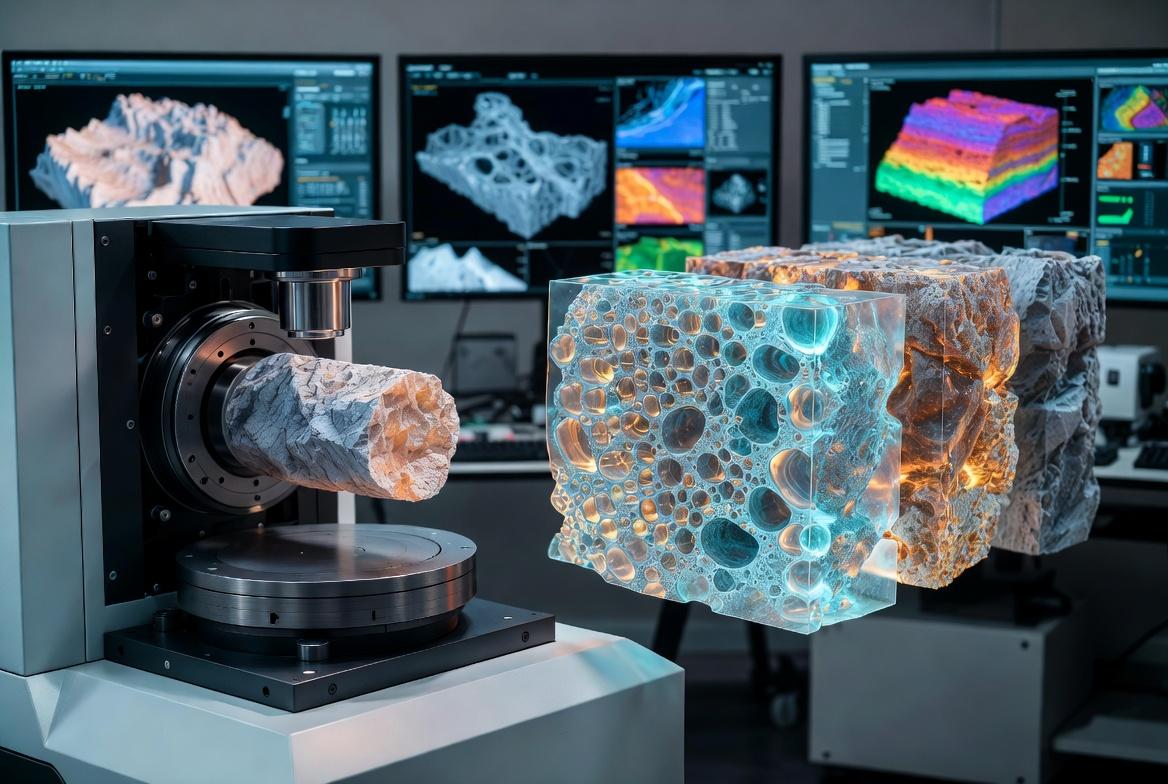
According to scientists, digital rock models have been actively used by geologists in recent years to assess how effectively rocks allow various liquids and gases – water, oil, carbon dioxide, or natural gas – to pass through them. This understanding is important for evaluating how groundwater moves through strata, as well as for predicting the efficiency and volume of mineral extraction or their storage in underground reservoirs.
The quality and speed of computer rock models heavily depend on the resolution chosen when scanning samples. Too coarse an image makes the model inaccurate: small pores permeating the rock are not visible. And high-resolution scanning requires a lot of time and computational resources. Therefore, scientists are looking for a "golden mean" – a precision at which the model is created with minimal time and cost.
Researchers studied samples of oil-bearing sandstone using a microtomograph. They scanned them six times, gradually reducing the sample size and increasing the resolution – from 16.3 microns to 1.6 microns. Then the images were combined, one area was selected on them, and a set of computer models was created based on these images.
The comparison showed that the quality of modeling stopped increasing after reaching an image resolution of 3–4 microns. This will significantly accelerate development in the future and reduce the cost of preparing models for similar fields. According to scientists, optimal resolution can be selected for other types of rocks in a similar way.
Read more on the topic:
Never miss our newsAdd this site to your preferred sources to see us more oftenAdd on Google

















