Scientists at St. Petersburg State University have proposed a new method for cooling semiconductors based on anti-Stokes luminescence. Instead of dissipating heat with fans and coolers, the material itself converts the energy of atomic vibrations into light emission, thereby cooling down. This discovery could lead to the creation of silent and compact cooling systems for processors, laser diodes, and optical sensors.
At the heart of the experiment is a three-layer "sandwich" structure: a central 14-nanometer-thick gallium arsenide film (5000 times thinner than a hair) is placed between layers of gallium, arsenic, and aluminum. This design creates a quantum well where the movement of electrons and holes is restricted in one direction, allowing for the formation of distinct excitonic resonances. Excitons – bound states of an electron and a hole – play a key role in the material's interaction with light.
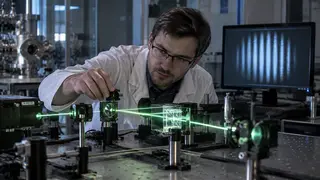
At ultra-low temperatures (around –269°C), physicists irradiated the structure with a laser, exciting only one type of exciton – those with a heavy hole. However, the emitted light registered photons from excitons with a light hole, which require more energy. The system drew the missing energy from the thermal vibrations of the crystal lattice, thereby cooling the material.
As Roman Nazarov, a research engineer at the Photonics Department of SPbGU, explained, the structure creates several closely spaced energy "steps" for excitons. The exciting light places the system on a lower step, and thermal vibrations of the lattice help it rise to a higher one, after which the system emits a more energetic photon. Although the work is fundamental in nature, its results lay the physical foundation for future technologies where excess heat can be dissipated with light – without fans and bulky cooling systems. This is especially important for photonic chips, compact lasers, and sensitive optical sensors.
Read more on the topic:
Never miss our newsAdd this site to your preferred sources to see us more oftenAdd on Google