The Russian X-ray telescope ART-XC named after M. N. Pavlinsky on board the Spektr-RG space observatory has for the first time isolated the intrinsic X-ray emission of the central stellar disk (CSD) of the Milky Way.

Spektr-RG has been operating since 2019 in a halo orbit around the Lagrange point L₂, approximately 1.5 million kilometers from Earth, moving with our planet in orbit around the Sun. The device creates a map of the Universe in the X-ray range and allows studying the most complex structures of the galaxy.
The CSD is an extended structure near the core of the Milky Way, previously studied mainly in the infrared range due to the absorption of visible light by interstellar dust. X-ray radiation with energies above several keV is able to penetrate through dust clouds, but until now it has been difficult to separate it from background radiation.
Russian scientists managed to isolate the extended X-ray glow of the CSD for the first time thanks to careful processing of ART-XC deep survey data. The morphology of the structure with a thickness of about 90 parsecs and a length of about 300 parsecs exactly corresponds to infrared observations.
The analysis showed that the radiation is associated with a collection of weak discrete sources, such as accreting white dwarfs in close binary systems. The total X-ray luminosity of the CSD in the range of 4-12 keV is estimated at 6×10³⁶ erg/s.
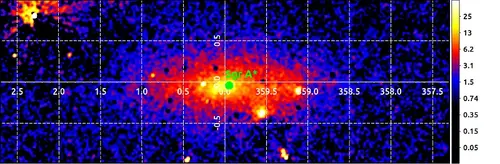
At the same time, the specific luminosity per unit of stellar mass is approximately three times higher than the same indicator for the "X-ray ridge" - extended radiation along the entire plane of the Galaxy. This indicates an increased concentration of compact systems in the central region.
ART-XC is an X-ray telescope created by the Space Research Institute of the Russian Academy of Sciences and RFNC-VNIIEF.
Read more materials on the topic:
- Russian ART-XC telescope on Spektr-RG, for some unknown reason, began to see the Universe better over the years
- ART-XC telescope allowed to study the center of the Galaxy in X-rays
- Russian astrophysicists for the first time recorded the intrinsic X-ray radiation of the Milky Way disk
Never miss our newsAdd this site to your preferred sources to see us more oftenAdd on Google

















