Translated with AI from the Russian original.
The largest sunspot complex of 2025, 4294-4296-4298, will be located on the central meridian of the Sun for the next three days, creating a period of maximum geoeffective impact on Earth. Two of the three regions have a Beta-Gamma-Delta magnetic classification - the highest level of risk for strong flares.
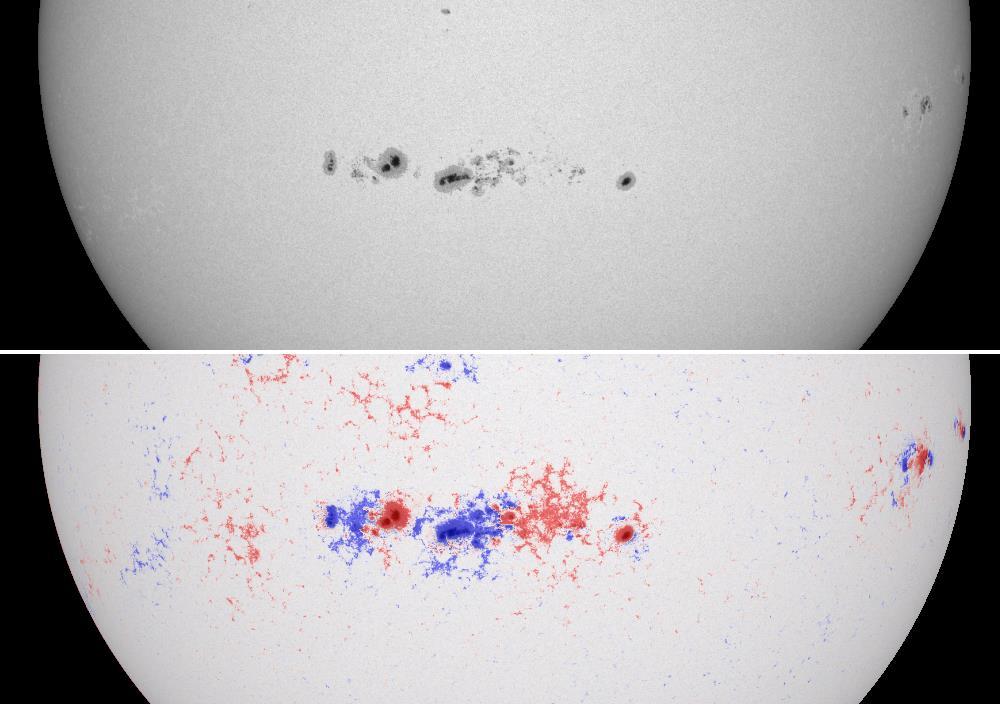
Sunspots are areas on the Sun's surface with a strong magnetic field, where the temperature is lower than in the surrounding photosphere. Magnetic configurations of the Beta-Gamma-Delta type are considered the most unstable and capable of causing powerful solar flares of level M and X. They can lead to auroras, radio communication disruptions, satellite electronics malfunctions, and even disruptions in power grids.
The total area of the complex exceeds 2000 m.d.p., and the central group 4294 with an area of about 1300 m.d.p. has become the largest in 2025 and the second largest in the current solar cycle after region 3664 in May last year. Region 4298 is considered less dangerous and has a Beta classification.
Despite the record size and "threatening" magnetic configuration, no M or X-class flares have been recorded in the last five days. Scientists are recording an increase in X-ray background and energy accumulation, but the reason for the absence of powerful flares remains unclear. The stable global structure of the complex may explain this, although local changes also do not lead to activity.
The main danger is the sudden formation of a new large spot in the center of the group or the rapid growth of an existing one. This can destroy the stable magnetic configuration and trigger avalanche-like flares. Experts expect that such events will not occur in the next three days, after which the complex will shift out of the zone of direct geoeffective impact.
Complex 4294-4296-4298 is unique not only in size but also in structure: despite its high energy, it demonstrates unusual stability, which reduces the likelihood of sudden powerful flares. Nevertheless, even small changes in the central group can drastically change the situation. Observations of such complexes help predict space weather and prevent potential consequences for the Earth's technological infrastructure.
Earlier, this complex of spots wascompared to Santa Claus on a sleigh.
Read more materials on the topic:
- "Complete Madness" - Astronomers in Confusion: The Most Powerful Flare Occurred on the Sun on December 1
- Five Flares of the Penultimate Power Class Occurred on the Sun in a Day
- Solar Flare Activity Reached Class M Level Again, Magnetic Loops Observed
Never miss our newsAdd this site to your preferred sources to see us more oftenAdd on Google

















