Translated with AI from the Russian original.
On September 23, a flare of the penultimate power class was recorded on the Sun, as reported by representatives of the Institute of Applied Geophysics (FSBI "IPG").
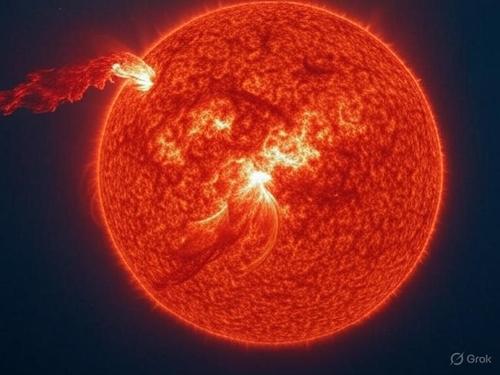
On September 23 at 13:34 Moscow time, an M1.0 flare (S03W24) lasting 26 minutes was recorded in the X-ray range.
The Laboratory of Solar Astronomy of IKI RAS and ISZF SB RAS noted that on September 23, a slightly increased flare activity is expected with moderate risks for the Earth.
Solar flares are classified according to the power of X-ray radiation into five classes: A, B, C, M and X. The minimum class A0.0 corresponds to a radiation power in Earth orbit of 10 nanowatts per square meter, and with each subsequent class, the power increases by 10 times. Flares can be accompanied by emissions of solar plasma, the clouds of which, reaching the Earth, can cause magnetic storms.
It should be noted that such phenomena can affect the operation of satellites and communication systems, so it is important to monitor solar activity.
Earlier www1.ru reported that a powerful flare was recorded by scientists on September 20.
Read materials on the topic:
- The Sun had its fourth powerful M-class flare of the day, with a top-class X-flare on the way
- A powerful M1.2 class flare occurred on the Sun lasting 10 minutes
- Five powerful flares occurred on the Sun over the past day: four class M and one class X
Never miss our newsAdd this site to your preferred sources to see us more oftenAdd on Google

















