The Russian biotech laboratory Neiry has successfully completed the world's first flight of a rat with a neural implant into the stratosphere. The experiment was conducted to study the interaction of the brain and artificial intelligence under critical loads - low pressure, radiation, and sudden temperature changes.
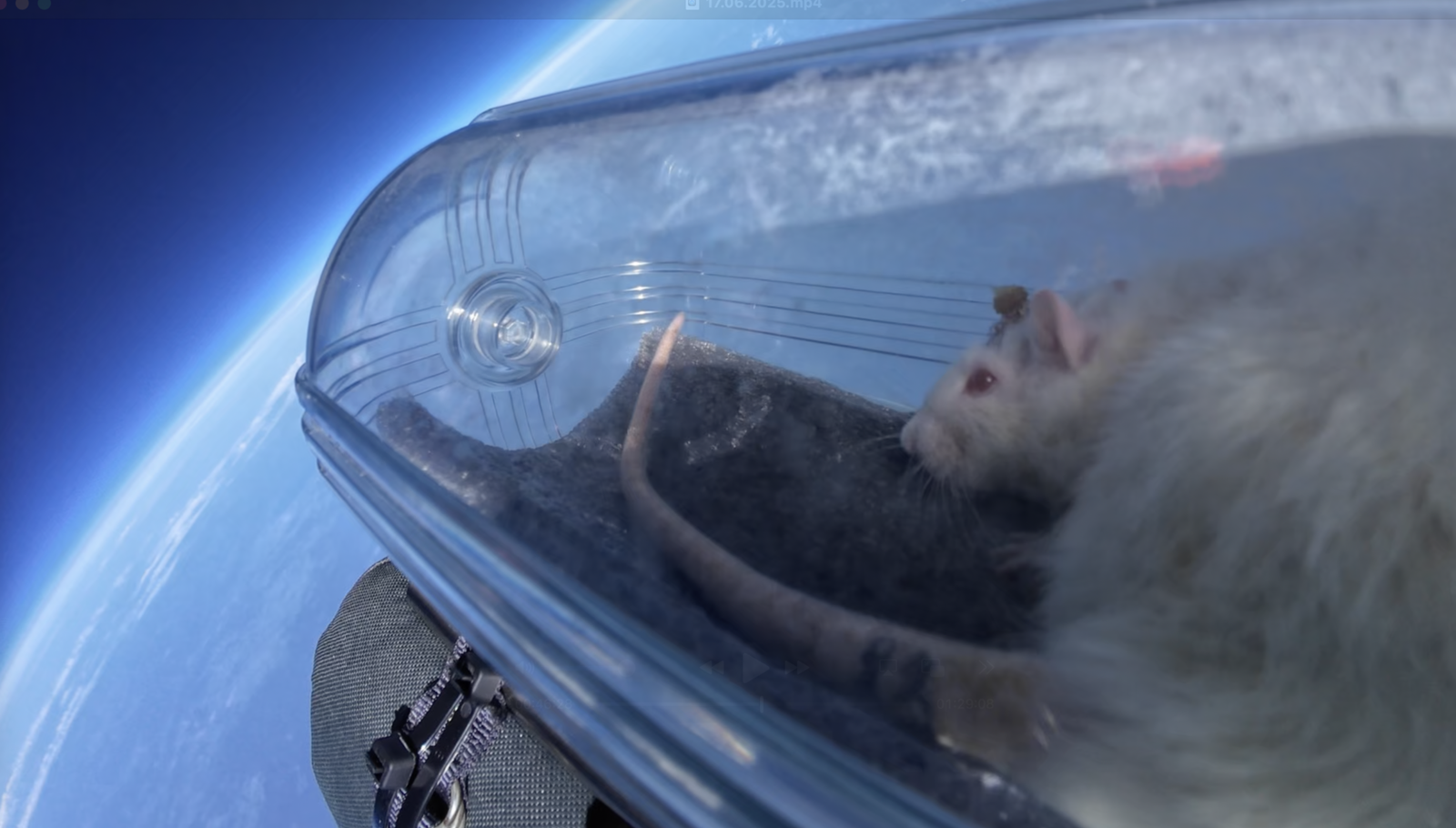
Key mission details:
- The launch took place in the Yaroslavl region, the Space Pi capsule rose to a height of 18,680 meters
- On board were 5 rats with invasive neural interfaces BCI (Brain-Computer Interfaces) and BAII (Brain-Artificial Intelligence Interfaces)
- The flight lasted 1.5 hours, after which the device landed 80 km from the starting point
- All experimental animals returned alive and in stable condition, and fully adapted after a day
The Space Pi capsule is a development of Russian engineers, equipped with a life support system, telemetry, and protection against pressure drops. This made it possible to maintain stable conditions for rodents even in the stratosphere.
Invasive neural interfaces with connected AI will become indispensable assistants for people in the future. And we believe that they will primarily be used in the most responsible positions and professions, such as pilots and astronauts. This means that such technologies need to be tested now.
Mikhail Lebedev, professor at Moscow State University and consultant of the project, added:
Once we are convinced that our technologies work reliably in the stratosphere, we will begin to look for an answer to the question of whether we can use the interaction between the biological brain and artificial intelligence in space to achieve certain types of neuroplasticity that we cannot achieve on Earth. For example, Pythia (the name of one of the rats sent to the stratosphere. Ed.) may learn something new in zero gravity and, as a result, receive new neural representations, retraining the nervous system. This will allow us to learn how the nervous system can work in space in synergy with artificial intelligence. We will receive valuable data that will form the basis of many scientific publications. In the future, complexes in which the biological brain and AI are connected will be able to solve many problems, including controlling spacecraft.
After landing, the rats were delivered to the laboratory of the Institute of Artificial Intelligence of Moscow State University for detailed analysis of the condition of the brain and implants.
Read more materials on the topic:
Providers cover 98% of the needs of the domestic market in cloud technologies
Neuroimplants for cows: Russian startup Neiry seeks to increase milk yield
Never miss our newsAdd this site to your preferred sources to see us more oftenAdd on Google