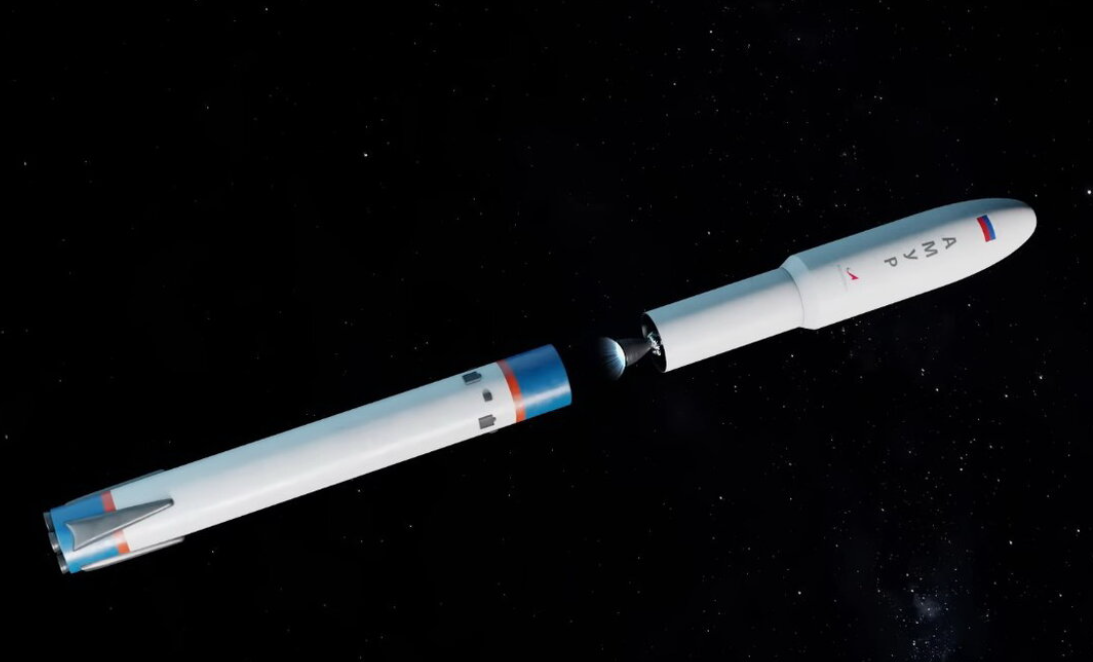
The launch of the promising methane-powered Amur rocket with a reusable first stage is scheduled for 2027-2028. This was announced by Dmitry Bakanov, General Director of Roscosmos, at the "Digital Industry of Industrial Russia" (CIPR) conference.
According to Bakanov, there is a possibility of trying to launch the rocket at the end of 2025, but he noted that such an attempt may not meet expectations.
To really make it a mature technology, we definitely need two and a half years. Therefore, the beginning of 2028 - the end of 2027 - is the period we will be aiming for.
The Amur rocket differs from the Soyuz-2 rockets of a similar class in the number of parts - 2 thousand versus 4.5 thousand. It is planned to make one fuel tank for two different fuel components, separated by a partition. This is due to the fact that the liquefaction temperature of methane and oxygen is approximately the same. These design features will reduce production costs.
The main difference between the Russian rocket and the American Falcon 9 is the type of fuel used (methane and kerosene). Methane is more accessible. This also greatly affects the cost of the launch, and also allows the use of ready-made infrastructure solutions.
Earlier, www1.ru reported that the technical design of the reusable Amur-SPG rocket will be completed by July 2025.
Read related materials:
Resources, attention, return: what is needed for the new Russian rocket of the Amur-SPG project
Creating the Amur-SPG rocket: the focus in development is on landing the first stage
A universal control system is almost ready for the new Russian Amur-SPG launch vehicle
Never miss our newsAdd this site to your preferred sources to see us more oftenAdd on Google

















