UEC (part of Rostec State Corporation) announced the development of a new program that will reduce the number of full-scale tests for aircraft engines. The product of the "Salut" production complex and Lomonosov Moscow State University is the first in the Russian engine industry to help conduct mathematical modeling of self-oscillations of gas turbine engine compressor blades and is already used in production.
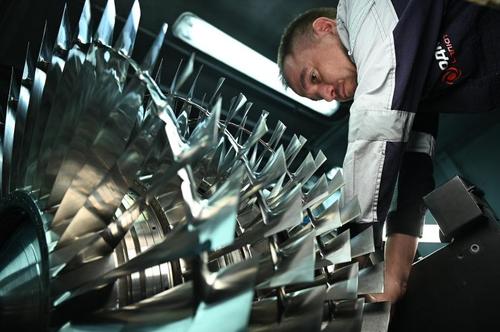
First, a methodology was developed for the timely detection and correction of self-oscillations (flutter) of gas turbine engine compressor blades at the design stage. Then, on its basis, software was created for performing such calculations automatically.
The developed software allows to obtain a significant economic effect from reducing the amount of testing and contributes to increasing the reliability of the engine. With the help of our methodology, for the first time in the domestic engine industry, the working wheel of the first stage of the low-pressure compressor was tuned out of self-oscillations using only numerical modeling. Usually, this required two or three cycles of full-scale tests.
The project was presented at CIPR in Nizhny Novgorod, it became a finalist of the "CIPR Digital-2024" award in the nomination "Digital Breakthrough in Industry". The development of the UEC subsidiary outstripped dozens of competitors: a total of 480 applications were submitted for the award from all over Russia, and only five projects became finalists in each of the nominations.
This is not the only development from the world of digital technologies in the work of UEC. For example, a high-performance supercomputer has already appeared for creating digital twins of aircraft engines. In particular, a digital twin will be created for the new Russian aircraft engine PD-8, which is being developed for the import-substituted passenger aircraft SJ-1006, this will help accelerate the engine certification.
Computer modeling allows to conduct virtual tests of both individual components of the power plant and the system as a whole. This way you can check the operability of the power plant when foreign objects, such as birds, get in.
Also, at one of the UEC enterprises, UEC-Saturn, AI is being introduced to check for defects in polished aircraft engine blades. In addition, this Rybinsk enterprise has already become the first among engine builders in Russia where augmented reality technologies are used in the assembly of gas turbine engines. Workers assemble aircraft engines in augmented reality glasses.
Read materials on the topic:
Russia is developing domestic software for sensors for rocket engineering, drones and oil production
Russia is transferring rocket and space technology to the domestic T-FLEX system
MS-21 aircraft performed automatic landing for the first time on Russian engines
Never miss our newsAdd this site to your preferred sources to see us more oftenAdd on Google

















