Translated with AI from the Russian original.
The Russian military has begun to use "anti-aircraft tachankas" — light anti-aircraft guns mounted on UAZ pickups, with Kalashnikov AK-12 assault rifles. They are capable of repelling attacks not only by single drones, but also by their swarms.
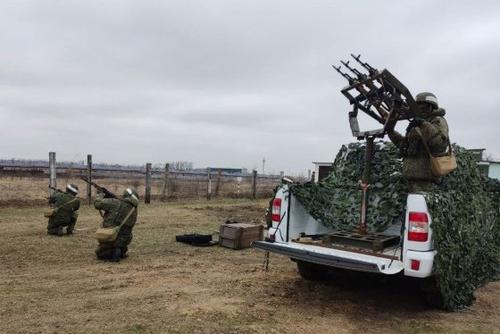
Anti-aircraft mounts for the AK-12 allow the weapon barrel to rotate 360 degrees horizontally and from plus 75 to minus 50 degrees vertically. Assault rifles are aimed at low-flying and ground targets in a matter of seconds.
The AK-12 is compatible with standard Kalashnikov magazines for 30, 45 and 60 rounds. That is, the new anti-aircraft gun is capable of firing 90, 135 or 180 rounds in a few seconds to engage a swarm of drones or a large kamikaze drone and destroy the target. The accuracy when firing in bursts is inherent in the characteristics of each AK-12.
Also, collimator, optical and night sights, flashlights and laser designators can be installed on these assault rifles using a Picatinny rail.
The AK-12 is an individual weapon of 5.45 mm caliber for the personnel of motorized rifle and other units of the Russian Armed Forces. The assault rifle is part of the Ratnik equipment. In the West, the advantages of Kalashnikov weapons have been repeatedly emphasized, including its accuracy and reliability. It has a rate of fire of 700 rounds per minute and an effective range of one thousand meters.
The assault rifle is constantly being modernized. The latest version received an updated diopter sight and forend, and work is underway to make the set of spare parts, tools and accessories more convenient for operators in combat conditions.
It is also known that the Khrulev Military Academy of Logistics recently patented a mount for the modernized Kalashnikov PKM machine gun. It has belts for 100 or 200 rounds of 7.62 mm caliber and engages targets at a distance of up to 1500 meters. Its rate of fire is 650 rounds per minute.
Never miss our newsAdd this site to your preferred sources to see us more oftenAdd on Google

















