The Multidisciplinary Clinical Medical Center of the Tyumen Region has received modern high-tech equipment. Under the national project "Healthcare", a high-precision Halcyon linear accelerator was installed in the Medical City, and a new X-ray diagnostic method, MRI diffusion of the whole body "Onkopoisk", was introduced. A new video-endoscopic 3D visualization system has also appeared there.
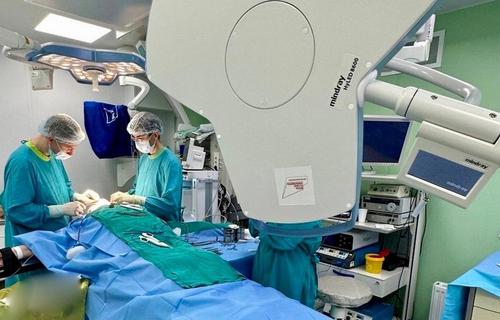
The equipment is used to perform operations on internal organs through a small incision. Thus, surgeons can perform the operation more accurately, relying on the image obtained, and the patient can recover more easily: the body spends less energy on healing the consequences of the operation than after a usual incision.
The Department of Health of the Tyumen Region notes that the region pays great attention to the introduction of the latest technologies and advanced medical equipment in medical institutions. And this means that other developments from among those that Russia has created recently may appear there.
For example, Tyumen surgeons will have the opportunity tooperate using a unique bioprinter that combines a robotic manipulator - a "robotic arm", a bioprinting system and computer vision. Scanning the wound surface, building a 3D model of the wound, and direct bioprinting using biological materials from the patient's body take place without the participation of a human doctor in the operating room with this method of operation. Or they will be able to use a uniquegel for 3D printing of artificial organs in their work, which will help hundreds of people waiting for transplantation.
Russian scientists are also developing a technology for4D bioprinting of organs in zero gravity. For the first time in the history of world space research, Russian cosmonauts at the ISS will begin creating tubular organs in space this spring. 4D bioprinting technology will allow obtaining equivalents of tubular organs, such as ureters or the urethra.
Never miss our newsAdd this site to your preferred sources to see us more oftenAdd on Google

















