Translated with AI from the Russian original.
Instead of computers assembled in Russia with domestic boards, devices that did not contain the declared Russian system units and other parts participated in public procurement.
Pseudo-domestic devices were included in the register of the Ministry of Industry and Trade and received high scores there after examination by the CCI. According to CNews journalists, thousands of such computers ended up in government agencies, for example, in the "Department of Information Technology and Communications" of St. Petersburg and hospitals in Voronezh.
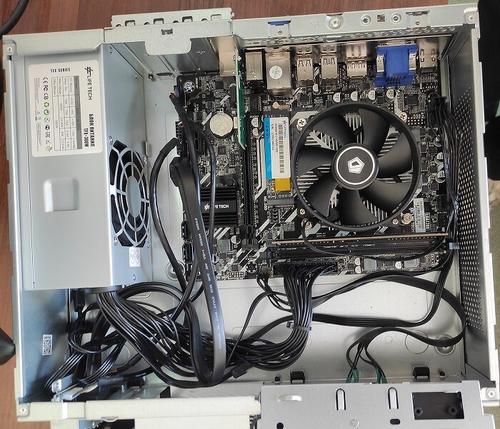
The examination report of the Chamber of Commerce and Industry showed that the Life Tech RS-Line system unit has a Russian motherboard from "Elpitech" and a Russian SSD drive from GS Group. For this, the system unit received the maximum 180 points for its category in the register of the Ministry of Industry and Trade.
However, in practice, when disassembling the unit, it turned out that there were no declared Russian components in it, but there was its own B450M-VHD-PLUS board and Life Tech SSD. They are entered in the GISP register, but do not have conclusions from the Ministry of Industry and Trade and are not in the register of Russian products.
"Elpitech" and GS Group stated that they had never cooperated with Life Tech and "RS Group". GS Group noted that they sell part of SSD disks through intermediaries, and, possibly, Life Tech bought their products in this way for the duration of the examination, and then took them out and inserted foreign "stuffing".
It cannot be ruled out that RS Group LLC could have purchased them in limited quantities: to get into the unified register of Russian radio-electronic products, and then replace them with Chinese analogues. This once again confirms the presence of counterfeit products on the radio-electronic products market, due to which domestic manufacturers suffer huge losses, are in no hurry to invest in the development of production and cannot compete with Southeast Asian countries in terms of product cost.
After the scandal, journalists also turned to representatives of "RS Group" and the Chinese manufacturer Onda, whose processors were most similar to the details of allegedly Russian computers, for comments, but have not yet received a response.
The Ministry of Industry and Trade told journalists that they would check the examination of the CCI, which issued a conclusion that Life Tech products are Russian.
Earlier, Ideco Director Dmitry Khomutov said about a similar situation of passing off wishful thinking as reality, due to which Russia is threatened by a boom in hacker attacks in early 2024. Companies officially buy Russian software, but in practice use foreign software, which is not updated in a timely manner, and this creates risks.
Never miss our newsAdd this site to your preferred sources to see us more oftenAdd on Google

















