Translated with AI from the Russian original.
There will be even more Russian spacecraft: it is planned to launch 387 "Made in Russia" satellites by 2030. This data is provided by the Telegram channel "Telekommunalka" following the results of SatComRus 2023, an international Russian conference on satellite communications.
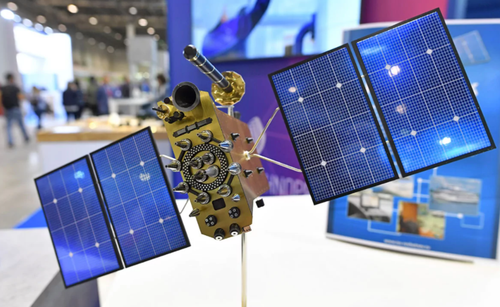
The production will be handled by ISS Reshetnev (JSC "Reshetnev", part of the Roscosmos State Corporation).
According to the management of "Reshetnev", it is planned to create an "ideal conveyor" for this. There, "Gonets" will be able to assemble "in about 200 days with a cycle of one week", and the recently presentedsatellite of the new constellation "Marafon IoT" - only "in 15 days with a cycle of almost a day".
We are already working on automated warehouses that use robotic systems, and we are modernizing production operations with various manipulators.
Each group of satellites by type of purpose will have its own key orbit. The smallest one will be for the "Marafon IoT" satellites for the Internet of Things: 750 km.
An orbit of 1500 km will be allocated for the "Gonets" mobile satellite service, and the orbit for the "Skif" satellite group providing broadband Internet access will be 8070 km.
Two more orbits - at 36000 km and 40000 km - will be allocated to satellites engaged in transport services: "Express", "Express-RV", and "Luch".
In general, the SatComRus 2023 fields predicted growth in the market for geostationary orbit devices by 2035. Now it is only 18 billion rubles, but in 2035 it may grow to 30 billion rubles.
However, there is another option for the development of Russian satellites, in which lower orbits will be used - less than 500 km. This private idea waspresented during the plenary session of the Agency for Strategic Initiatives (ASI) forum "Strong Ideas for a New Time" to Russian President Vladimir Putin. The head of state supported the idea.
Never miss our newsAdd this site to your preferred sources to see us more oftenAdd on Google

















