The latest hit in your playlist might not have been written by a human. Since the end of 2025, the music industry has seen a trend of increasing numbers of tracks fully generated by neural networks, as well as AI artists in general, said Danila Konstantinov, director of the KION Music service. According to KION Music, they account for about 30% of the chart. What are AI tracks, how to tell if music was made by a robot, and what is the market situation – read in our article.
What are neurotracks?
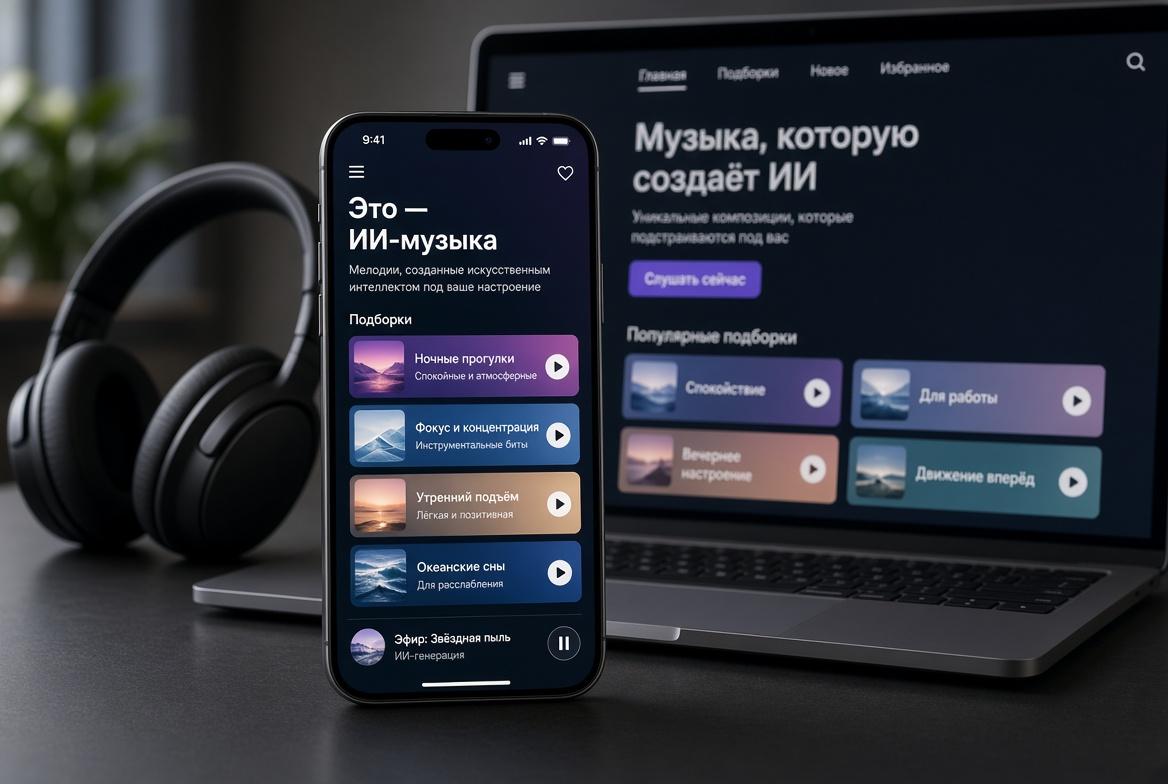
Neurotracks are musical compositions entirely or largely created using artificial intelligence. A neural network can write song lyrics, assemble music and samples, process vocals, arrange, and post-produce – that is, take over the entire "kitchen" of track creation.
Such compositions are uploaded to streaming services under various names, and listeners do not always realize that the song was not created by a human.
How much AI music is there in Russia?
The context in which neurotracks are growing is also impressive. According to the National Federation of the Music Industry (NFMI), in 2024, the volume of the music streaming market in Russia exceeded 37.6 billion rubles, an increase of almost 48%. The overwhelming share – 96.9% – is occupied by Russian services (Yandex Music, VK Music, Zvuk, MTS Music).
One of the first public Russian experiments at the intersection of streaming and generative AI: the duo Filatov & Karas, together with Sber's neural networks, created the track and video "Spoiler" through the STUDIO application of the Zvuk service. At the time, it was perceived as a curiosity; today, according to Zvuk, every tenth new release on the platform contains music fully or partially generated by AI.
By the end of the year, the share of such content is likely to continue to grow as generative tools develop and spread. The demand for releases will still depend primarily on their quality and listener reaction.
We do not observe a significant surge in complaints. Users, as a rule, evaluate the track itself and cannot always determine whether it was created using AI.
Sergey Mudrik, editor-in-chief of VK Music, declined to disclose the share of AI-generated music but noted that among notable releases, the share of AI content is insignificant.
A representative of Yandex Music stated that the platform plans to give artists and rights holders the opportunity to be open with their listeners and inform them whether AI was used in the creation of music, because only they can know for sure.

How to tell if a track was made by a robot
There are two ways to find out about the use of AI in a track. The first is when the rights holder who uploaded the release to the platform reports it. The second is when music service specialists identify characteristic signs during profile verification: a neural network image, a small amount of released content, lack of information about the artist in the media and other open sources, says a representative of Zvuk.
Technically, we can identify an AI track, but at the current level of technology development, there is always a risk that a work in which neural networks were used only partially – along with manual author's work – will also fall under suspicion.
Various legal and technological mechanisms for protecting musical works are used worldwide, including digital watermarking, says Oleg Rogov, head of the "Trusted and Secure Intelligent Systems" research group at the AIRI Institute.
It is embedded directly into the audio track, which subsequently makes it possible to determine, for example, that the recording was obtained as a result of illegal broadcasting or unauthorized copying. Digital watermarks also often allow determining the origin of a track and establishing whether it was created using a specific AI model.
Each AI model has its own signature that it leaves. Now many models add neural network digital watermarking, which is already resistant to several consecutive remixes.
At the end of 2024, the National Federation of the Music Industry proposed to ban the monetization of works created by neural networks: according to NFMI estimates, the financial losses of live artists from neuro-covers could reach 3.5 billion rubles annually. At the same time, a conflict of positions emerged – large technology companies insisted that AI should be considered a tool, not an author.
What about AI music labeling in Russia?
There is no separate labeling for AI tracks and virtual performers in the service. Representatives of VK Music and KION Music did not comment on the presence of labeling in their services.
It is difficult to accurately determine the degree of neural network participation in the creation of a work, as it can be used for text work, sample creation, vocal processing, arrangement, or post-production, a Zvuk representative listed.
However, the mere fact of using AI is not a reason to remove content: if the release is placed according to all rules, rights are correctly formalized, and the interests of rights holders are not violated, it is presented in the service on par with other music.
What artists and labels say
Not all musicians are thrilled with the new wave. The voice and stage image of popular artists are often copied. Against the backdrop of the rapid growth of AI content in playlists, the industry expects clarification of legal norms governing the use of digital twins and the payment of royalties to authors.
Russia's chief "Yasaul" Oleg Gazmanov compared the arrival of AI in music to the appearance of synthesizers and spoke in favor of "taming" the technology for the benefit of the industry, rather than banning it.
Abroad, live musicians are already fiercely fighting their digital clones. Songs not recorded by humans do not make it into the charts there.
Read more on the topic:
Never miss our newsAdd this site to your preferred sources to see us more oftenAdd on Google