In 1999, the Kargil Conflict began between India and Pakistan: at that time, Indian military personnel faced a serious problem – they did not know the exact location of enemy positions, writes Indian Defense Research Wing. The mountainous terrain concealed fortifications, and early reconnaissance missions on MiG-21s and the British-French Jaguar did not provide sufficiently accurate information. The use of British reconnaissance aircraft and Canberra bombers also did not help – they lacked specialized long-range optical systems. At that time, India also did not have high-resolution satellite imagery suitable for immediate tactical application.
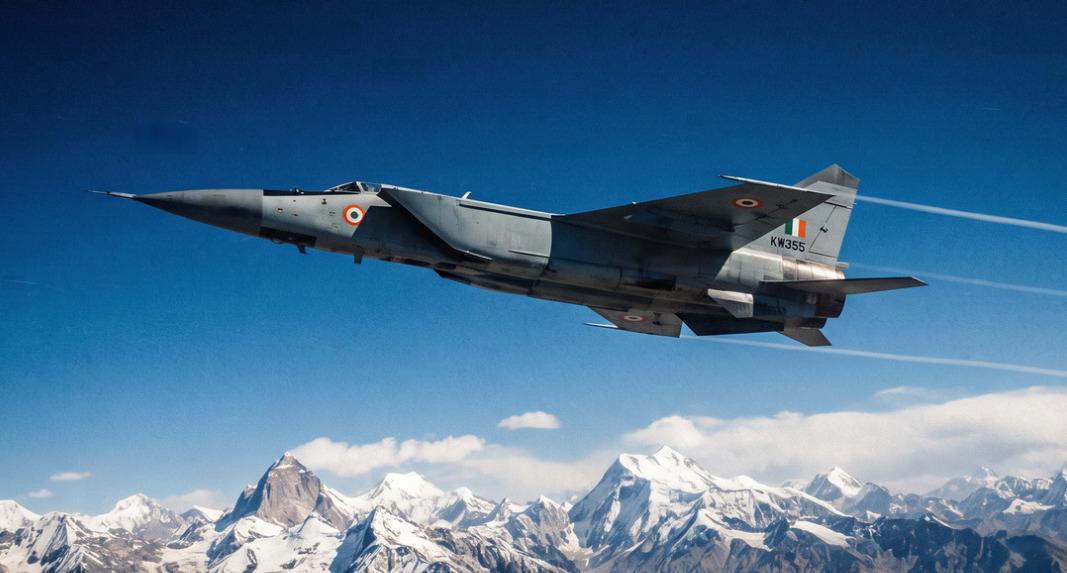
Filigree Work of the MiG-25 in the Himalayas
At this point, the Indian command turned to its most powerful reconnaissance aircraft – the supersonic MiG-25R. Developed in the USSR to intercept American bombers, it could reach speeds of up to Mach 3 and climb to an altitude of over 20 kilometers, remaining out of reach for most air defense systems of that time. Equipped with powerful cameras with a focal length of up to 1800 mm, it could conduct aerial photography from a great distance, making it an ideal tool for reconnaissance in the conditions of the Kargil Conflict.
The Indian Air Force decided to use the MiG-25 in an unconventional mode: flying at an altitude of 13 km at minimum afterburner, reaching a speed of about Mach 1.3. This allowed for images with sufficient resolution to detect camouflaged enemy fortifications. The risk was high, but the mission was approved, and in just three secret MiG-25 sorties, almost the entire conflict zone was photographed.
Turning Point of the Kargil Conflict
The obtained images were crystal clear. They showed not only enemy positions but also their logistics chains and supply routes. This information dramatically changed the course of the campaign. The Indian command received an accurate picture of the enemy's forces, which allowed for planning effective airstrikes. Mirage 2000s and MiG-27s, using coordinates obtained by the MiG-25, struck key fortifications. The accuracy of the intelligence also helped ground troops in assaulting important heights.
Silent but Decisive Contribution of the Soviet Fighter
Although the Indian MiG-25 was never used with weapons in this conflict, its contribution was decisive. It demonstrated that strategic reconnaissance in a modern conflict can be a key factor in victory. The Kargil War became one of the last operations of the MiG-25 in the Indian Air Force. With the development of satellite technologies and remote sensing systems, its film cameras gave way to digital systems, and in 2006, the legendary reconnaissance aircraft was decommissioned.
Read more on the topic:
Never miss our newsAdd this site to your preferred sources to see us more oftenAdd on Google