Translated with AI from the Russian original.
Imagine a clear May day in 1987. In Moscow's Red Square, where the footsteps of tourists and the chimes of the Kremlin clock usually echo, the hum of a small plane is heard. A light Cessna 172 Skyhawk, piloted by 18-year-old German Mathias Rust, makes a daring landing right by the Kremlin walls. This flight, which began as a youthful escapade, became an event that shook not only the Soviet Union but the entire world. How could one small plane bypass the most powerful air defense system?
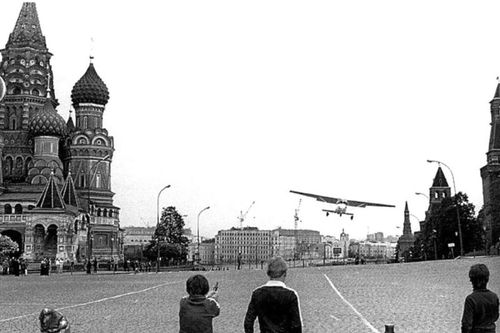
In the 1980s, the Soviet Union prided itself on its air defense system (ADS) - a true "sky fortress." Hundreds of radars, anti-aircraft missile systems, and fighters guarded the country's airspace, which was considered one of the most protected in the world. The S-200 and S-125 complexes, capable of hitting targets at altitudes of up to 20 kilometers, were ready to shoot down any object - from an enemy bomber to a spy plane. According to Colonel-General Rasil Akchurin, who participated in the air defense inspection on the day of the incident:
One missile could destroy the intruder with absolute precision.
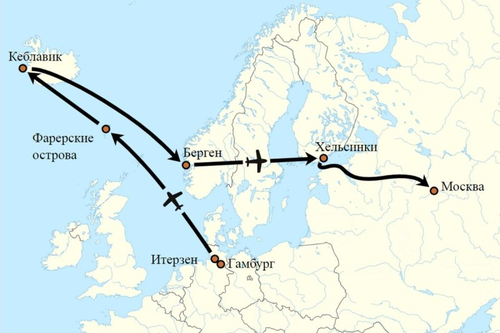
But on that day, May 28, 1987, this powerful system failed. Mathias Rust, a novice amateur pilot from West Germany, flew more than 800 kilometers over the territory of the USSR in his small plane without encountering resistance. His Cessna, flying at an altitude of only 600 meters, was detected by radars near the city of Kohtla-Järve in Estonia at 14:29. However, no one gave the order to shoot down or intercept the intruder.
Mathias Rust was not just an adventurer. At the age of 18, he already had a pilot's license and about 50 flight hours. His flight, in his own words, was a "call for peace" - a gesture aimed at easing the tense relations between East and West during the Cold War. Rust began his journey in Hamburg, made a stop in Helsinki, and then headed to Moscow. His plan sounded crazy: to land in the heart of the USSR to draw attention to the ideas of peace and dialogue. But this "call for peace" turned into an international scandal. After landing on the Bolshoy Moskvoretsky Bridge, near Red Square, Rust was arrested. The court accused him of hooliganism, violation of aviation laws, and illegal border crossing. In September 1987, he was sentenced to four years in prison, but in August 1988, he was released under amnesty, having spent 432 days in prison.
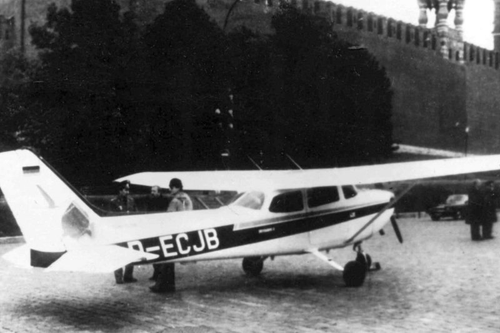
The Rust incident revealed vulnerabilities that the USSR preferred not to talk about. Firstly, a low-flying aircraft proved to be a difficult target for air defense systems, which were configured to detect large and fast objects, such as military aircraft. Rust's Cessna, flying at an altitude of 600 meters at a speed of about 200 km/h, was almost invisible to radars. Secondly, the human factor played a role. As General Akchurin recalled, commanders on the ground did not dare to act without a direct order:
There was no command, and we have no right to open fire on light aircraft. One of the generals even suggested that the radar was detecting not an airplane, but a flock of geese - a ridiculous mistake that became fatal.
But the main reason for the failure lay deeper - in bureaucracy and indecision. The military was afraid to make radical decisions, fearing the consequences. A fighter jet that spotted the Cessna received an order to land, and the commander-in-chief of the air defense, Marshal Alexander Koldunov, learned about the incident too late. The result was a large-scale purge in the military leadership: Minister of Defense Sergei Sokolov, Air Defense Commander-in-Chief Alexander Koldunov, and Air Force Commander Alexander Yefimov were dismissed.
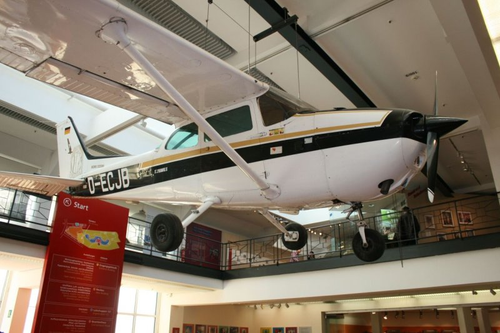
Mathias Rust's flight is a story that seems incredible even after almost four decades. A young man in a small plane bypassed one of the most powerful defense systems in the world, reminding everyone that technology is not only machines but also the people behind them. This incident forced scientists and engineers to take a fresh look at air defense systems, laying the foundation for modern technologies that protect the sky over millions of people.
Read more on the topic:
Manufacturer of S-500 "Prometheus" SAM systems will open an air defense service center abroad
Say the "Password": How Russian air defense avoids "friendly fire" in "friend-or-foe" mode
Pocket air defense system: a new "Yolka" interceptor drone has been developed for the military
Never miss our newsAdd this site to your preferred sources to see us more oftenAdd on Google

















