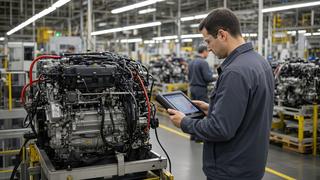
A regular service Lada Largus was turned into a laboratory on wheels. MGTS engineers installed six fiber-optic sensors on it — four on the suspension, one on the engine, and one on the gearbox — and taught the system to find malfunctions even before the car breaks down.

Fiber optic sensors do not require power at the measurement points, are resistant to electromagnetic interference, and allow multiple sensors to be connected to a single unit. All sensors are connected to a single measuring unit — the system turns on automatically after the engine starts, collects data, and sends it to the cloud via a cellular network.
Tests were conducted in real-world conditions — cold start, city traffic jams, accelerations, braking, long idling, driving on uneven roads. The system understands whether the car is moving or standing by the suspension vibrations, records changes in revolutions by engine signals, and the sensor on the gearbox catches characteristic transmission vibrations.
Data is currently being accumulated. Next, the system will be synchronized with the car's telemetry — revolutions, speed, load — and algorithms will be trained to identify anomalies and predict breakdowns before they occur. In the future, the technology can be applied not only to service and industrial transport, but also to unmanned platforms and in engineering infrastructure monitoring systems.
Read more on the topic:
Never miss our newsAdd this site to your preferred sources to see us more oftenAdd on Google