Specialists from VNIKTI (Kolomna, part of Russian Railways) are testing a prototype of a ballastless track superstructure for the Moscow — St. Petersburg High-Speed Mainline. The rail slab is installed on a foundation and connected with self-compacting concrete, and special mats simulating the subgrade are laid underneath. Rails and fastenings are installed on the resulting "track cake", after which the structure is placed on a durability stand capable of aging it by half a century in a month.
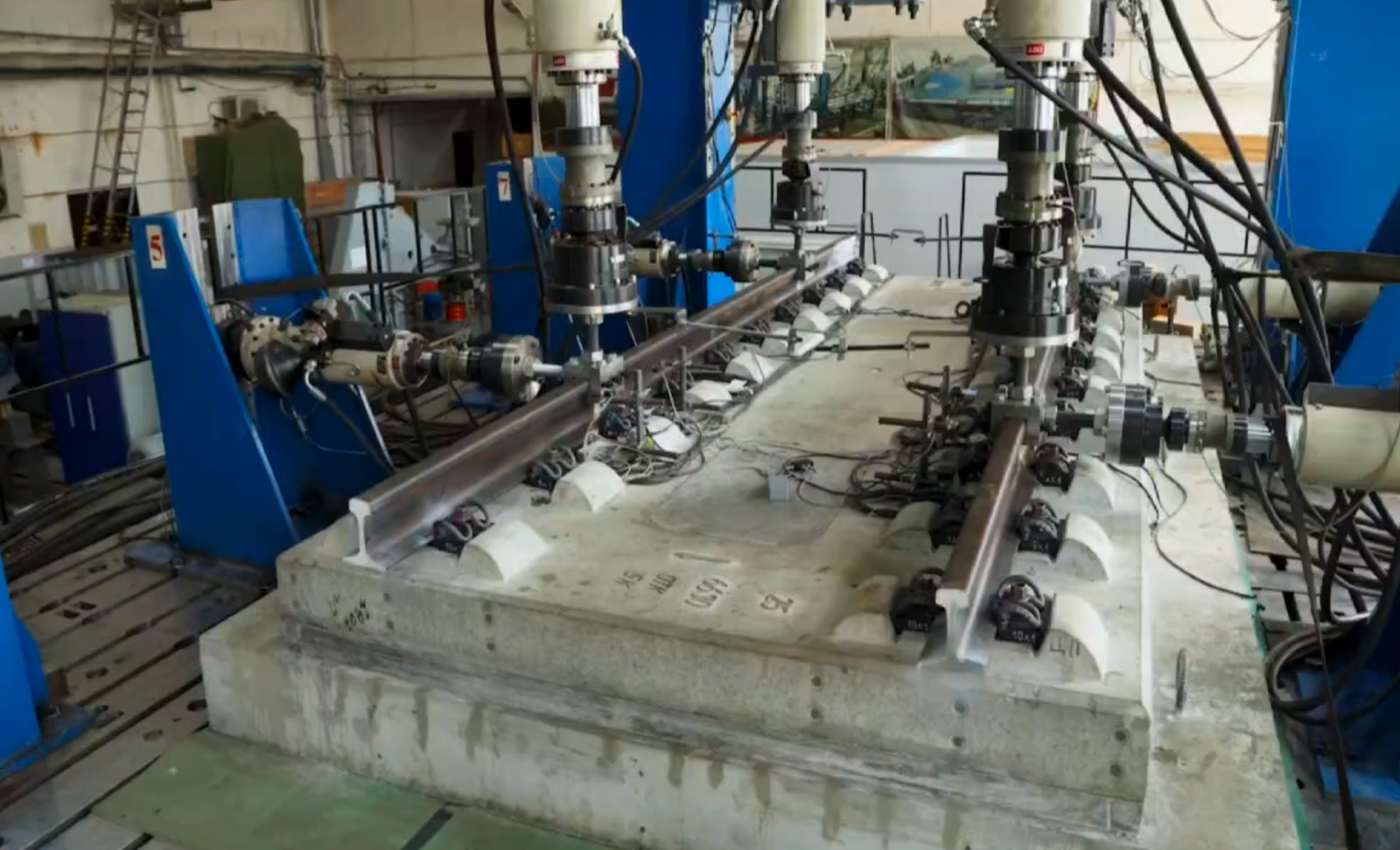
The structure is affected by 8 pulsators, 4 in horizontal and 4 in vertical planes. Every second they alternately press on the track, and the total axial load reaches 75 tons — almost twice the calculated impact of an HSM train. Strain gauges record any deformations, and the structure itself must withstand 9 million cycles in a month, equivalent to 50 years of operation.
The Moscow — St. Petersburg High-Speed Mainline, with a length of 679 km, will be the first HSM in Russia. Trains will be able to reach speeds of up to 400 km/h, and travel time will be reduced to 2 hours 15 minutes. Construction began in March 2024, with launch scheduled for April 2028. The total cost of the project is estimated at 2.1 trillion rubles. The mainline will become part of the international North-South transport corridor.
Read more on the topic:
Never miss our newsAdd this site to your preferred sources to see us more oftenAdd on Google