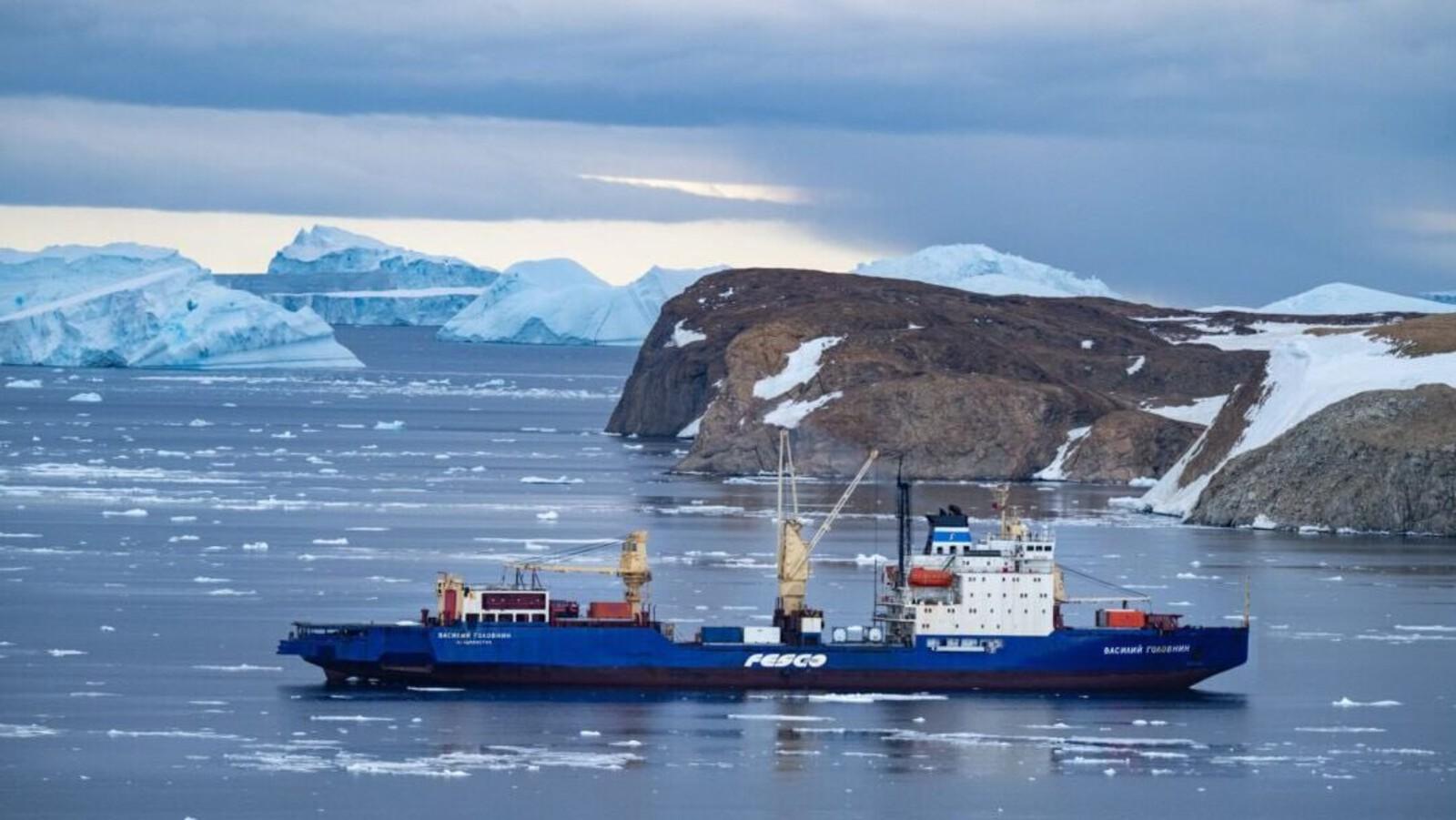
The diesel-electric ship of Project 10620 "Vasily Golovnin", operated by the Fesco Transport Group (an enterprise within the management contour of the Rosatom State Corporation), has departed from the port of Cape Town and is heading towards the coast of Antarctica. On board the ship is a cargo of vital importance for two Indian research stations: "Bharati" and "Maitri". This is the eighth expedition organized by Fesco under a long-term contract with the National Centre for Polar and Ocean Research (NCPOR), which is under the jurisdiction of the Indian Ministry of Earth Sciences.
The voyage will last until April 2026. In addition to food, fuel, and technical equipment, the ship carries members of a new expedition - Indian polar explorers who will replace the current staff at the stations.
The design features of "Vasily Golovnin" allow it to effectively perform logistical tasks in extreme Antarctic conditions. The ship is equipped with two cargo cranes and a self-propelled barge, which ensures the possibility of unloading directly onto the shore even in the absence of port infrastructure. To support operations on land, two helicopters are stationed on board, which will be used both for aerial reconnaissance of the ice situation and for transporting cargo to hard-to-reach areas.
During stops at the stations, the Fesco crew will participate in supporting scientific work, providing logistical and technical support to researchers. The expedition is led by experienced ice captain Iksan Yusupov, who has extensive experience in polar waters.
"Vasily Golovnin" is an icebreaking transport diesel-electric ship built in 1988. It is named after Vasily Mikhailovich Golovnin (1776-1831), a Russian navigator, explorer of the Pacific Ocean and the Kuril Islands
Read more materials on the topic:
- The navigation bridge was installed on the nuclear icebreaker "Chukotka" - a 170-ton structure took its place
- At the shafts of 120 MW: Rosatom delivered the first batch of fuel for the RITM-400 reactors of the icebreaker "Russia"
- The Baltic plant equipped the nuclear icebreaker "Leningrad" with compressors for emergency power supply
Never miss our newsAdd this site to your preferred sources to see us more oftenAdd on Google

















