Roscosmos cosmonaut Alexei Zubritsky, acting as a TASS special correspondent, spoke in detail about the progress of the "Mirage" experiment on board the International Space Station (ISS). The project aims to grow semiconductor single crystals in microgravity conditions, which could lead to a breakthrough in materials science and electronics.
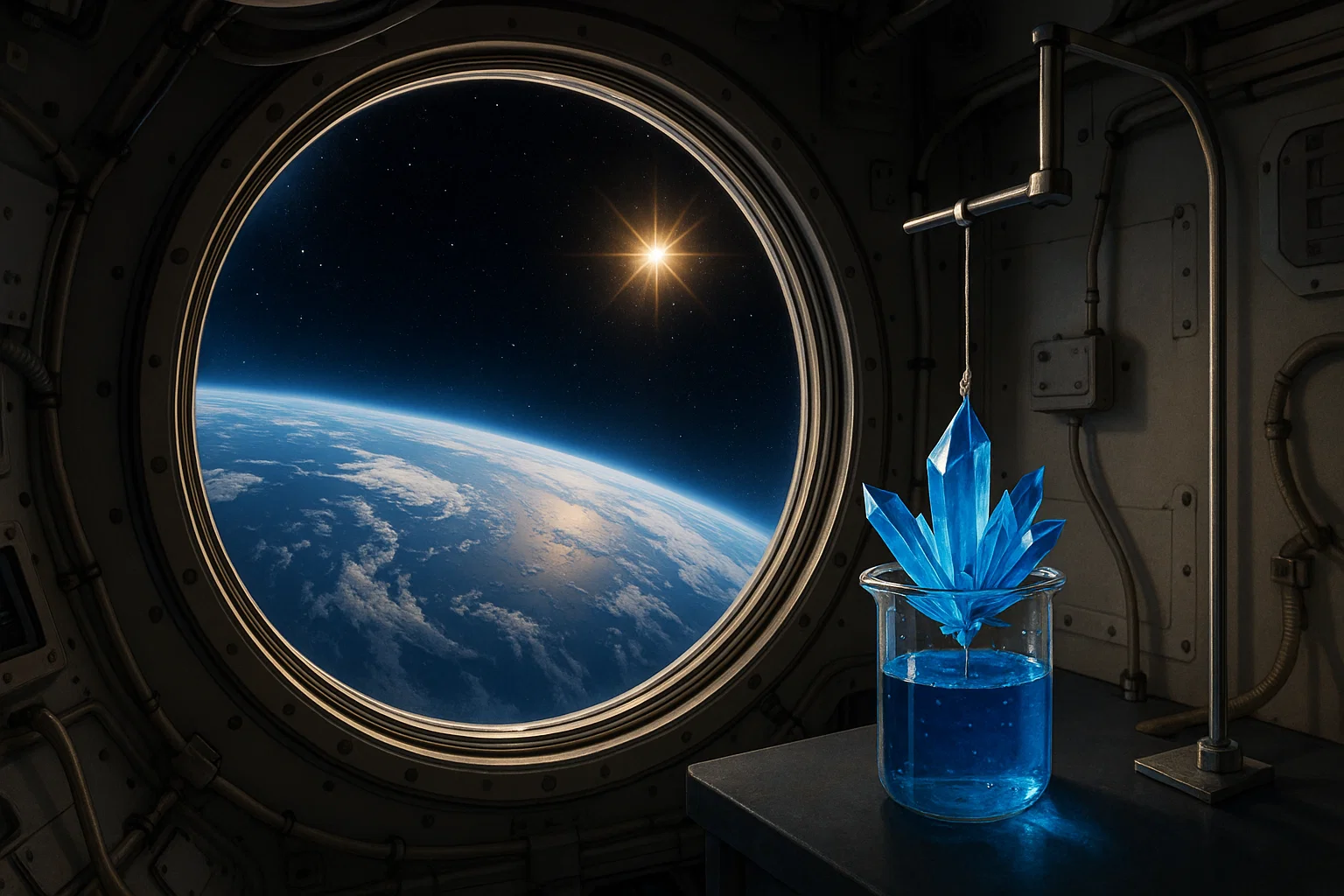
According to Zubritsky, the process involves several stages: installing a heating unit, placing a test container with the material, evacuating the furnace, and subsequent melting.
On Earth, it is possible to obtain crystals of the same purity, but it is easier to do this in space. In terrestrial conditions, special chambers and a lot of energy are required to create a vacuum, while on the ISS it is enough to open several valves to connect the furnace to the external vacuum.
The crystals are more homogeneous and become more valuable scientifically. He noted that on Earth, similar results require complex vacuum chambers and high energy consumption, while on the ISS it is sufficient to use the external vacuum.
The "Mirage" experiment was developed by the Kurchatov Institute and has been conducted since 2009. Its main goal is to study the possibilities of creating perfect semiconductor crystals in space. The resulting samples will be delivered to Earth for further analysis, which may open up new prospects for the electronics industry.
Read more materials on the topic:
"Aseptic" Experiment on the ISS: Cosmonaut Wagner Shares Details of Scientific Research
"Neuroimmunity" Experiment: Cosmonaut Wagner Shows How to Collect Venous Blood in Weightlessness
Never miss our newsAdd this site to your preferred sources to see us more oftenAdd on Google













![Growth Point: After 5G Launch, Mobile Internet in Russia Accelerated by 20%","subtitle":"TelecomDaily recorded an upload speed increase of 19.7%, and download speed of almost 14%","announce":""}[]}],](https://media.ixbt.site/fit-in/320x/ixbt-data/1727896/ai-image-nvgq0a0v5cjnyxwoc8xpelva.webp)