Translated with AI from the Russian original.
Roselectronica has begun supplying new generation equipment for the creation of supercomputers. They will be used in "one of the largest industrial companies in Russia", which is not publicly named. The equipment includes high-performance servers, 24-port switches and adapters of the new generation "Angara" high-speed network - after modernization, the solution has become more compact.
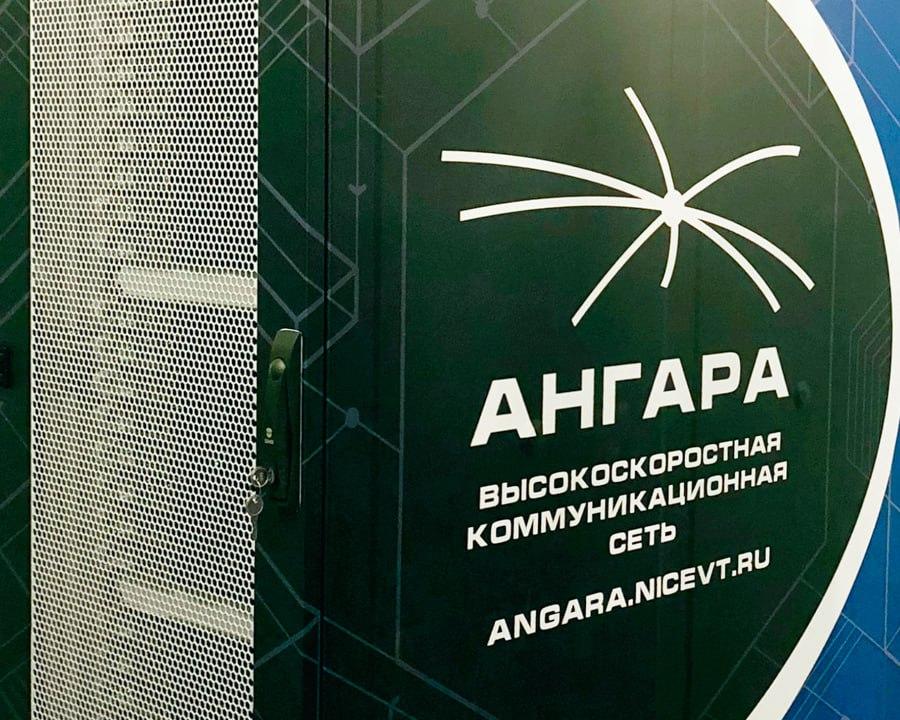
The "Angara" network equipment from NICEVT combines servers into a single computing cluster. It performs calculations with high-intensity information exchange and ultra-low data transfer delays between cluster nodes.
We have made the first deliveries of the new generation of "Angara" network equipment, the development of which was completed in 2023. The equipment is installed on the territory of two research organizations. The devices allow even more efficient execution of tasks to create modern Russian supercomputers for solving complex scientific problems. Today, the success and speed of scientific research, and therefore the development of domestic industry, largely depends on such equipment
The "Angara" Network
This is the first project in Russia of a high-speed network with routers based on domestic development: ultra-large integrated circuit (ULSI) ES8430.
ULSI ES8430 is a product of JSC "NICEVT" (ULSI), a developer of supercomputer technologies, computing equipment, electronic modules and blocks. NICEVT is part of the Roselectronica holding of the Rostec State Corporation.
In terms of capabilities and characteristics, ULSI ES8430 surpasses all Russian developments in this direction.
Characteristics of ULSI ES8430:
- released at the TSMC factory using 65 nm technology;
- crystal size - 13.0 × 10.5 mm;
- number of transistors - 180 million;
- operates at a frequency of 500 MHz and consumes 20 W;
- supports the "multidimensional torus" network topology (variants from 1D to 4D-torus are possible);
- each network node can have up to 8 connections with neighboring nodes, the bandwidth of each connection is 75 Gbps;
- interaction with the computing node - via the PCI Express 2.0 × 16 interface.
The "Angara" network supports OS based on the Linux kernel and OS Astra Linux Special Edition, as well as parallel programming tools OpenSHMEM, MPI, OpenMP. It has a reliable data transmission protocol over the communication channel, while routing bypasses failed nodes and communication channels.
The network power consumption is up to 20 W. Key characteristics of the "Angara" network include:
- 4D-torus network topology;
- adapter based on ULSI
- 8 communication channels;
- MPI latency 0.85 μs;
- hop latency 130 ns;
- scaling up to 32K nodes;
- switch and switchless design;
- RDMA and GPUDirect support;
- data transmission media - both copper and fiber optics.
It is known that there are seven supercomputers based on the "Angara" network in the Ministry of Defense, industrial and scientific organizations. In particular, these are the Angara-K1 supercomputers in NICEVT itself, Desmos and Fisher in the Joint Institute for High Temperatures of the Russian Academy of Sciences.
Read materials on the topic:
A computing cluster with more than 200 teraflops is being launched in Novosibirsk
MAI has increased the power of the supercomputer to 380 teraflops: new prospects for research in the field of vibroacoustics
Never miss our newsAdd this site to your preferred sources to see us more oftenAdd on Google

















