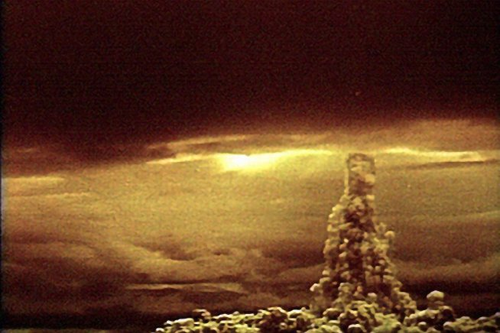
On October 30, 1961, the most powerful thermonuclear charge in history, the AN602 (the so-called "Tsar Bomba"), was tested at the Novaya Zemlya test site at half power. With a design energy reduction to ~50%, the actual explosion power was 52.5 megatons of TNT equivalent. The event demonstrated both technical achievements and large-scale geophysical and environmental effects.
Creating the Bomb
The idea of a super-powerful charge - on the order of 100 Mt - was voiced in 1961 (initiated by Yu. A. Trutnev) and received the support of a number of leading scientists (A. D. Sakharov, Yu. B. Khariton, Ya. B. Zeldovich). In February 1961, the heads of KB-11 raised the issue of developing a supercharge in a letter to the Central Committee, and on July 10, 1961, at a discussion in the Central Committee of the CPSU, a decision was made to resume testing and create a superbomb. Work with compressed deadlines was carried out at KB-11 (VNIIEF) under the scientific supervision of A. D. Sakharov.
Charge Design
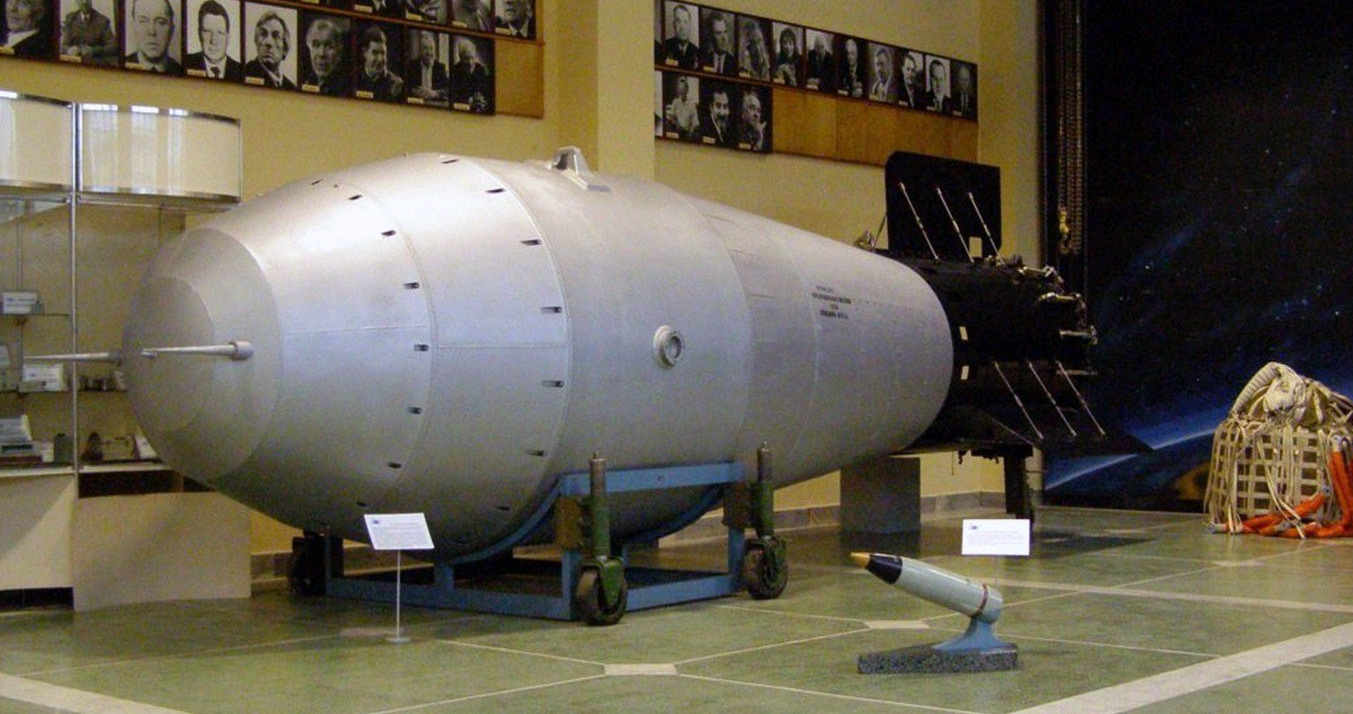
The charge was a two-stage thermonuclear system with radiation implosion and a number of design innovations - in particular, a biconical ("bifilar") scheme for synchronous ignition. Due to the large dimensions of the charge, the carrier aircraft was modified (Tu-95-202 received an external suspension). The parachute system and the air bomb body (RN-202) were developed at NII-1011 and MNII PDS; at the same time, due to the lack of computing power, calculations were performed on all available computers, and final modifications were made manually. Thus, A. D. Sakharov's proposal to install lead belts 60 mm thick was later confirmed by calculations as critical for correct implosion.
Observations and Consequences
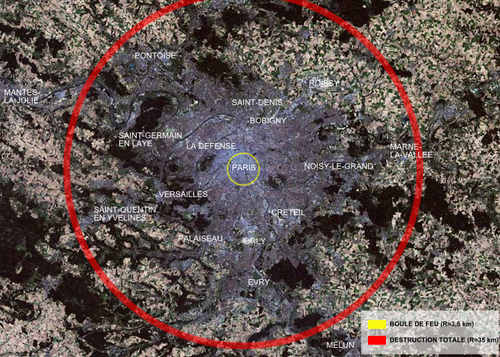
The explosion was visible from more than a thousand kilometers away. It was observed in Norway, Greenland and Alaska. The nuclear mushroom rose to 67 kilometers and had a two-tiered "hat" with a diameter of 95 and 70 kilometers. The cloud spread over 800 kilometers. The shock wave circled the Earth three times in 36 hours and 27 minutes. The sound wave reached Dixon Island (about 780-800 kilometers) and knocked out windows there. At the same time, even Amderma (280 kilometers) did not report any destruction. The atmospheric pressure wave also circled the planet three times and was recorded in Wellington (New Zealand) from October 30 to November 1. Amplitudes were 0.6-0.2 millibars at an average speed of 303 meters per second. The seismic wave circled the globe three times. The radioactive contamination zone within a radius of 2-3 kilometers gave levels of about 1 milliroentgen per hour. Two hours later, the testers arrived at the site, as the radiation situation did not pose a mortal danger, although it was locally significant. Strong ionization of the atmosphere caused radio interference for hundreds of kilometers for about forty minutes.
Evaluation of Tests
The AN602 test became a demonstration of technical potential and, at the same time, a mobilization of scientific and engineering resources in an extremely short time. The result confirmed the possibility of achieving the grandiose power of thermonuclear charges, but also emphasized the large-scale geophysical and environmental consequences of such tests, which became one of the factors that increased international interest in limiting and banning atmospheric nuclear tests in subsequent years. The scientific leadership of the project, in particular A. D. Sakharov, were awarded the highest state awards.
Conclusion
The AN602 test on October 30, 1961 is a historical example of a combination of high scientific thought, emergency engineering solutions and large-scale consequences, easily readable in geophysical and meteorological records around the globe. It left important lessons and technical developments, but also clearly demonstrated the price of super-powerful weapons for nature and humanity.
Earlier www1.ru reported thatthe reactors of the Burevestnik and Poseidon can be used for peaceful purposes.
Read more materials:
- Russian multipurpose nuclear submarines are "lost" during repairs, but are trying to catch up with deadlines
- Rare MiG-15Rbis returned to life: the legendary reconnaissance aircraft was restored in the Kaluga region
- From under the ax: the Russian military equipped the 152-mm self-propelled howitzer "Acacia" with "Buratino" dynamic protection
Never miss our newsAdd this site to your preferred sources to see us more oftenAdd on Google

















