Penza designer Alexander Gorshkov developed an isobaric piston engine for an unmanned aircraft. The scheme provides for one cylinder, a receiver with pre-compressed combustible mixture, and a system of automatic valves to control its movement.
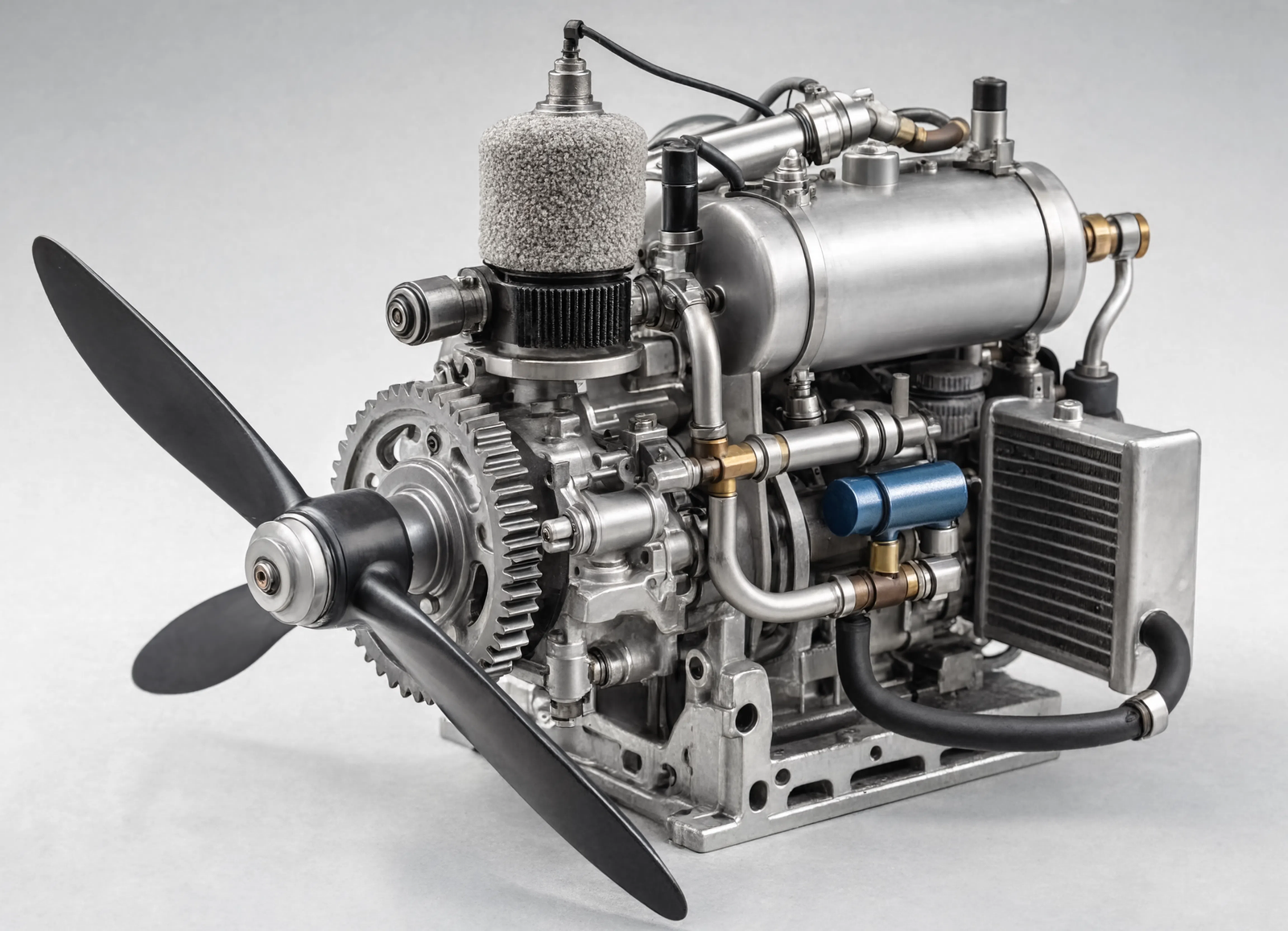
After the working process, the mixture from the cylinder is directed back to the receiver, and then re-enters the engine. One of the valves is responsible for admitting the mixture from the carburetor, the second for pumping it back into the receiver.
An unusual solution is proposed for cooling. Gorshkov suggests covering the outer surface of the cylinder and its cover with a porous capillary material filled with coolant. A pump should pump it through a radiator from the bottom of the coating to the top.
Moreover, the aircraft's skin itself can act as a radiator in the design. A capillary coating is also provided on its inner side, and the smooth outer surface should dissipate heat to the airflow.
Another unusual detail is the propeller drive. It is connected to the crankshaft via an angular gear transmission located in the horizontal tail of the aircraft. At the same time, the driving gear simultaneously performs the functions of the crankshaft cheek and counterweight.
From the editors: we note that the isobaric cycle in the piston version already suffers from low thermal efficiency. The idea of reusing gases without radically updating the chemical composition will inevitably turn the engine into an inefficient "smoker" choking on its own exhaust.
Nevertheless, this is not the first such scheme from Gorshkov. Earlier, he proposed a design for an isobaric internal combustion engine with 8 cylinders.
Read more on the topic:
Never miss our newsAdd this site to your preferred sources to see us more oftenAdd on Google