The Russian company Geoscan has completed the largest project in Saudi Arabia for prospecting gold deposits using drones. The survey covered an area of about 1 thousand sq. km, with a total flight route length of approximately 10 thousand linear kilometers.
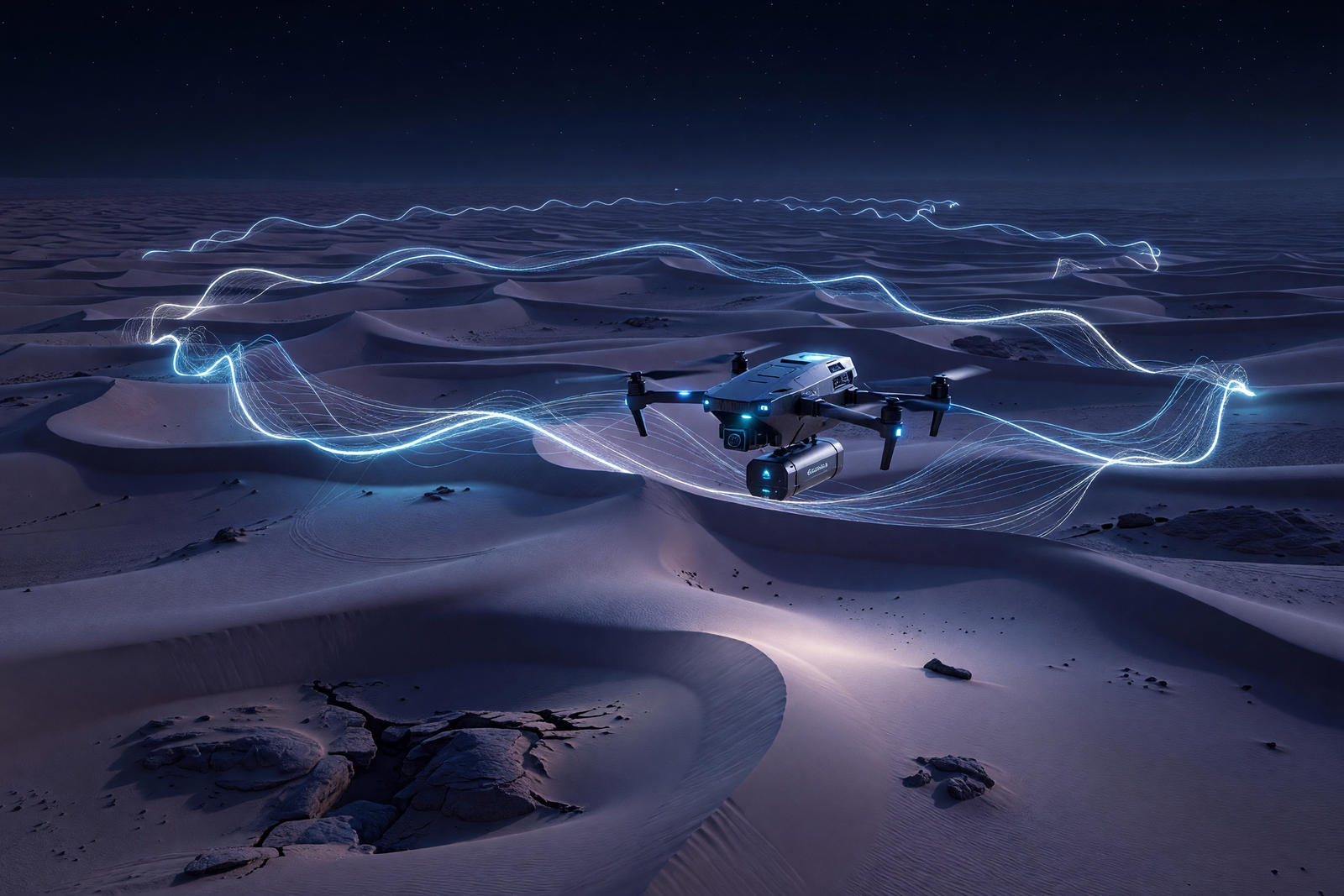
The project used an aerogeophysical complex based on the Geoscan 401 quadcopter with a Geoshark quantum magnetometer. The complex is designed for geological mapping, identifying structures and faults. The work lasted 52 days and was carried out mainly at night due to high air temperatures.
Since 2017, Geoscan has been developing geological exploration technologies using drones. The company has performed magnetometric and gamma-spectrometric surveys at more than 160 sites in Russia and abroad, including in Central Asian countries, Africa, and on the Arabian Peninsula. The total length of routes exceeded 200 thousand linear km. Customers include mining and oil and gas enterprises.
We have previously reported on the use of Geoscan drones for mineral exploration: at the end of 2024, the company tested the Geoshark quantum magnetometer during a survey of Ambaital Island in the Feni archipelago (Papua New Guinea) — about 90 sq. km were surveyed despite tropical downpours and unpredictable winds. At that time, specialists suggested a high concentration of gold in the area.
The geological exploration capabilities of drones are not limited to gold: Russian geologists, using unmanned technologies, have identified seven new deposits of minerals — titanium, chromium, uranium, and manganese — in the Far East and Siberia. And the Alpha-E drone from the Kalashnikov concern performed almost 1000 linear kilometers of aeromagnetic survey during ore prospecting in the Khabarovsk Krai.
Read more on the topic:
- Moscow Region from Above: Geoscan Completes World's Largest Drone Aerial Photography Project
- Cheaper for Subsoil Users: Demand for Geological Exploration with Drones Grows in the Arctic
- Ore Deposit Exploration Strategy Algorithm Developed by Scientists at Kola Science Centre of the Russian Academy of Sciences
Never miss our newsAdd this site to your preferred sources to see us more oftenAdd on Google

















