The Russian machine tool industry largely remains at a basic level of automation. An APKIT study supported by the Ministry of Industry and Trade (November 2025 – February 2026, 39 enterprises) showed that 41% of productions use manual labor with minimal automation. Another 59% use automated machines and lines where loading and control are partially performed manually. The sample did not include enterprises with complex robotization, MES/SCADA integration, or end-to-end digital automation from order to shipment.
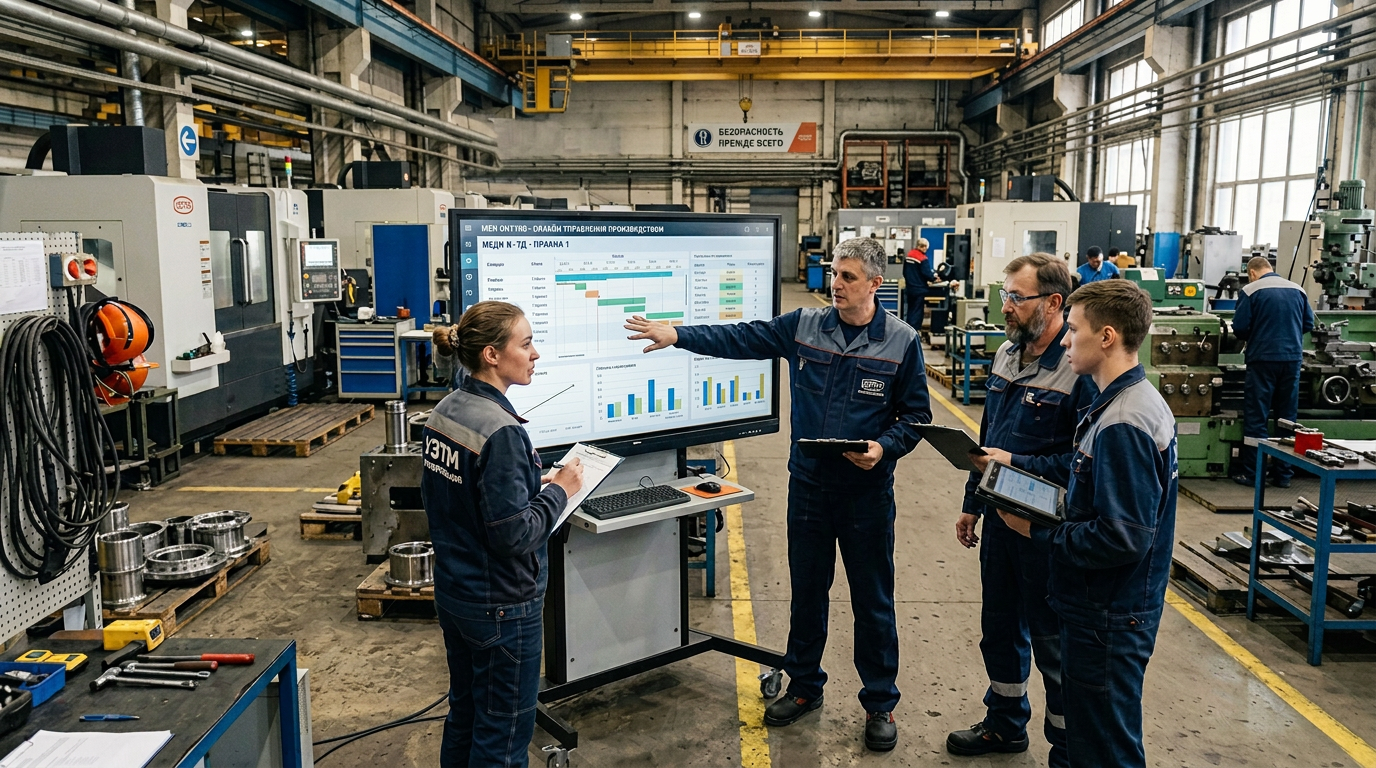
Only 10% of respondents use MES for real-time production management, and 56% use PLM elements. Demand is focused on the basic product development circuit (CAD/CAM/CAE and PDM), while digital twins, Big Data, AI, VR/AR, and APC, RTO, CAQ, HMI class systems are used sporadically. 82% of companies do not have a written IT strategy; digital transformation is not considered a key element of business strategy.
The IT infrastructure for 49% is formed and has a development plan, for 51% it only covers basic needs or has significant gaps. Regarding software, 49% use only Russian solutions, 28% plan to replace foreign ones, 13% are already implementing domestic alternatives, and 10% allow for a mixed model. All participants noted the need for new software: 30% implemented it in critical areas, 8% are actively implementing it, 31% are ready for pilots, and 21% are limited by resources.
The technological conclusion is obvious: without the integration of MES, industrial analytics, and robotization, it is difficult for the industry to transition to highly automated production circuits and increase the predictability of quality and deadlines.
Read more on the topic:
Never miss our newsAdd this site to your preferred sources to see us more oftenAdd on Google

















