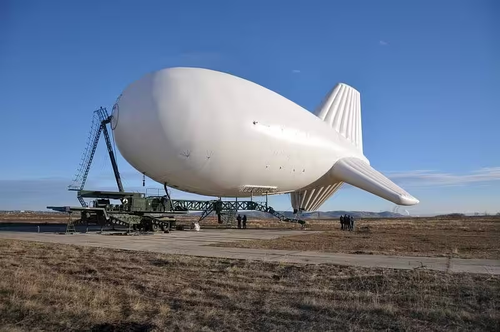
The idea of raising huge aerostats into the air to monitor kamikaze drones looks good only on paper, but in practice it is doomed to failure. This was stated by rocket engineer, author of the Telegram channel "Russian Engineer" Alexey Vasiliev.
According to him, high-altitude stratospheric drones, which are much cheaper to operate and more practical, are better suited for this purpose.
Moreover, a huge disadvantage of aerostats is an order of magnitude greater windage and difficulties with holding them in place.
Vasiliev explained that the mass of the tether cable at high altitude becomes decisive.
Installing any propulsion unit and turning an aerostat into an airship requires a supply of fuel, which destroys the whole point of such a platform.
At the same time, it became known last year that the Russian military began using stationary aerostats with retransmission modules of the meter range (from 30 to 180 MHz), as well as the upper frequencies of the meter and lower frequencies of the decimeter wave range (220-470 MHz). However, such platforms areused to provide communication, and not to monitor drones.
Read more materials on the topic:
Never miss our newsAdd this site to your preferred sources to see us more oftenAdd on Google