Translated with AI from the Russian original.
Superconductivity is a unique state in which materials conduct electricity without resistance or energy loss. Today, it is only achieved at extremely low temperatures (below −140 °C), which limits its widespread use. However, researchers from the Center for Quantum Metamaterials at MIEM HSE together with scientists from MIPT, MEPhI, and the Federal University of Pernambuco (Brazil) have discovered a way to overcome this barrier.

The key breakthrough is related to managing defects - disruptions in the crystal lattice of a material. Instead of fighting inevitable defects, the team proposed distributing them according to specified patterns, creating a "correlated disorder." Professor of MIEM HSE Alexey Vagov explains:
Imagine a crowd of people moving chaotically in different directions - this is classical disorder. Now imagine the same people moving in a complex but coordinated pattern, like in a mass dance - this is what correlated chaos looks like. It turned out that in superconductors, such disorder leads to the fact that defects begin to contribute to superconductivity.
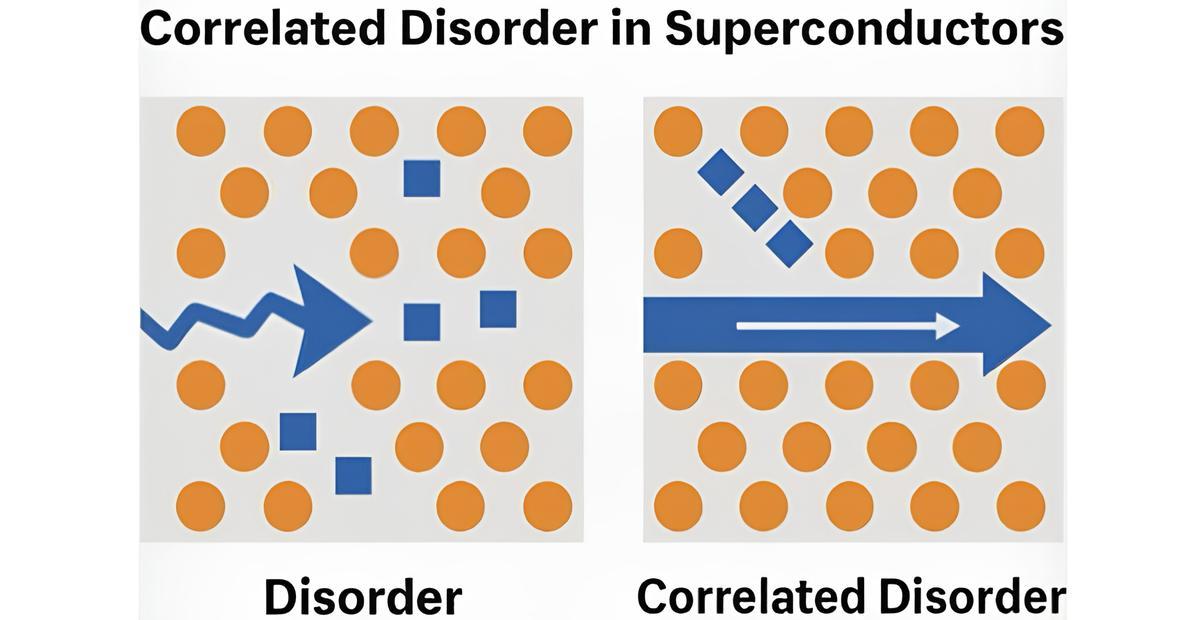
In traditional materials, the transition to a superconducting state occurs in stages: first, isolated "islands" appear, which unite only with further cooling. Modeling of two-dimensional systems has shown that correlated disorder changes this process: superconductivity instantly covers the entire material at a higher temperature.
The discovery is especially relevant for thin superconducting films. By setting the location of defects at the synthesis stage, engineers will be able to design materials with desired properties. Regulating the location of defects at the micro level may be the key to creating superconductors that will operate at much higher temperatures - perhaps even at room temperature. In this case, superconductivity will cease to be a phenomenon available only for scientific experiments and will become available for use in everyday life.
Read more materials on the topic:
Russian scientists have started developing import-substituted ceramic sensors for microelectronics
Hundreds of times faster: an algorithm accelerating the design of patch antennas has been developed by MIPT scientists
Never miss our newsAdd this site to your preferred sources to see us more oftenAdd on Google

















