Today, around 11:00 Moscow time, space observatories recorded one of the most powerful plasma ejections in recent years. The cloud of superheated matter was formed as a result of the destruction of a giant prominence on the far side of the Sun, which had not previously been observed from Earth. The event was captured thanks to the work of orbital telescopes, including Russian devices.
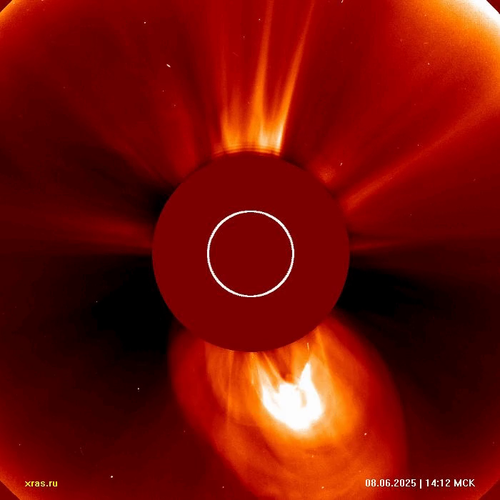
According to the Solar Astronomy Laboratory of the Space Research Institute of the Russian Academy of Sciences, the ejection is characterized by an unusually high density, and its trajectory remains in question. Currently, scientists believe that the plasma is moving at a large angle to the Earth, possibly even in the opposite direction. However, final conclusions can only be made after additional calculations.
This is the second major ejection in the last 10 days, which indicates high solar activity. Unlike the previous event, which caused a series of magnetic storms, the current ejection is unlikely to affect the Earth. Nevertheless, scientists will continue monitoring to clarify the parameters of the plasma movement.
Read more on the topic:
Mysterious object larger than Earth, resembling a bird or spaceship, spotted above the Sun
Weather-sensitive people can relax: the geomagnetic storm that began on June 1 has subsided
Never miss our newsAdd this site to your preferred sources to see us more oftenAdd on Google

















