The Russian observatory \"Spektr-RG\" has made a unique discovery - the quasar SRGA J2306+1556, which has remained invisible for decades due to a dense veil of gas and dust. This cosmic object, located 4 billion light-years from Earth, has become one of the rarest examples of superactive galactic nuclei hidden from direct observation.
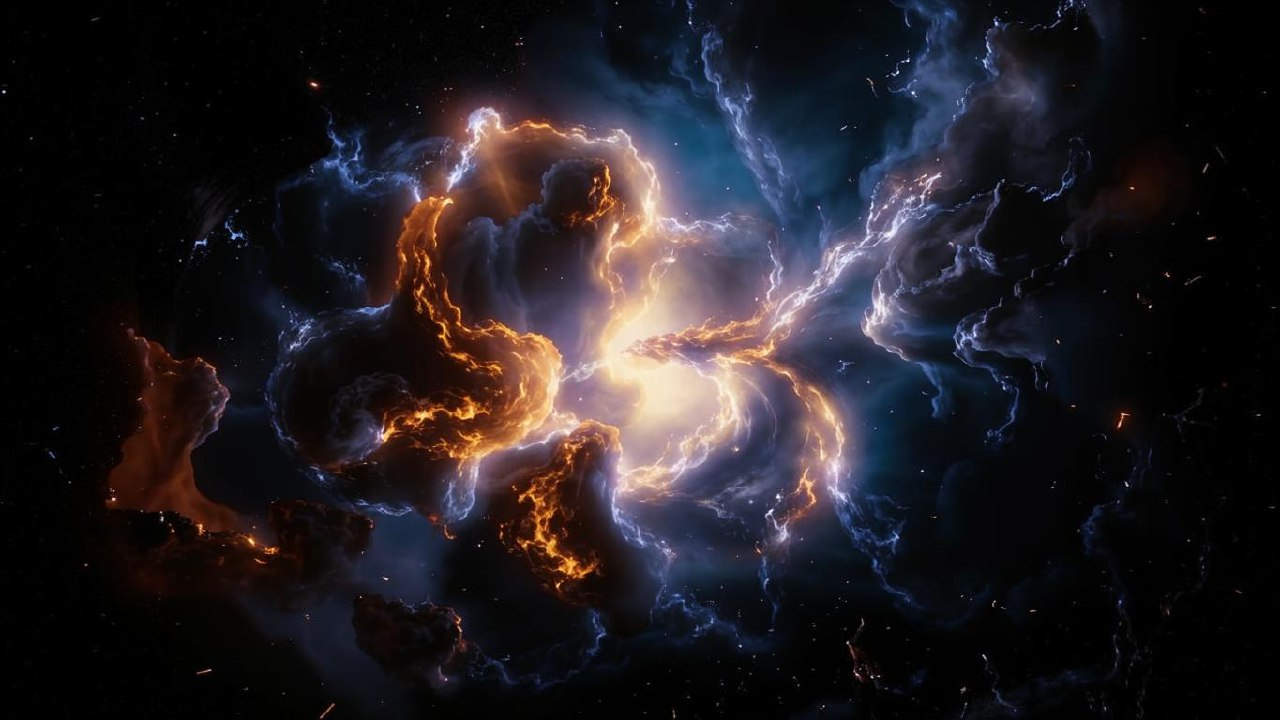
The quasar works like a giant cosmic accelerator - its supermassive black hole, weighing 1.4 billion suns, absorbs matter, heating it to millions of degrees. The resulting X-ray glow is 6 times brighter than that of ordinary objects of this type. However, most of the radiation is absorbed by a gas \"shield\", the density of which is equivalent to a layer of lead several kilometers thick.
SRGA J2306+1556 is interesting not only for its brightness, but also for its unusual behavior. Over several years, its X-ray brightness has decreased sixfold, although no fluctuations were observed during the 20-hour observation. This may indicate long-term changes in activity associated with an uneven flow of matter falling on the object. In the radio range, it looks like a triple structure: in the center is the nucleus, and on the sides are two symmetrical \"lobes\" resembling ejections of matter moving almost at the speed of light.
This discovery raises questions about how such quasars go unnoticed. Usually, bright objects with a low redshift (z < 0.5) are easy to detect, but SRGA J2306+1556 remained out of sight of scientists for decades. Researchers suggest that it may be in a transitional state, when the active nucleus begins to \"blow away\" the surrounding gas clouds, becoming visible to observers.
Further research is planned using new generations of eROSITA and Athena telescopes, which will be able to find similar objects hidden in \"X-ray shadows.\"
Understanding the evolution of such quasars will help to reveal how supermassive black holes affect the formation of galaxies, and why some of them remain invisible even in the relatively close part of the Universe to us.
Read more materials on the topic:
Russian cosmonauts are actively involved in the creation of the future ROS
Russia is building a new 120-ton solar telescope-coronagraph
Never miss our newsAdd this site to your preferred sources to see us more oftenAdd on Google