Russian specialists have created an exoskeleton that can significantly ease heavy physical labor. The development by NIU MGSU is designed for builders and can reduce the load on the operator by up to 80%. The new exoskeleton consists of four main parts: lumbosacral-pelvic, femoro-tibial, ankle modules, and a support frame with an anatomical curve.
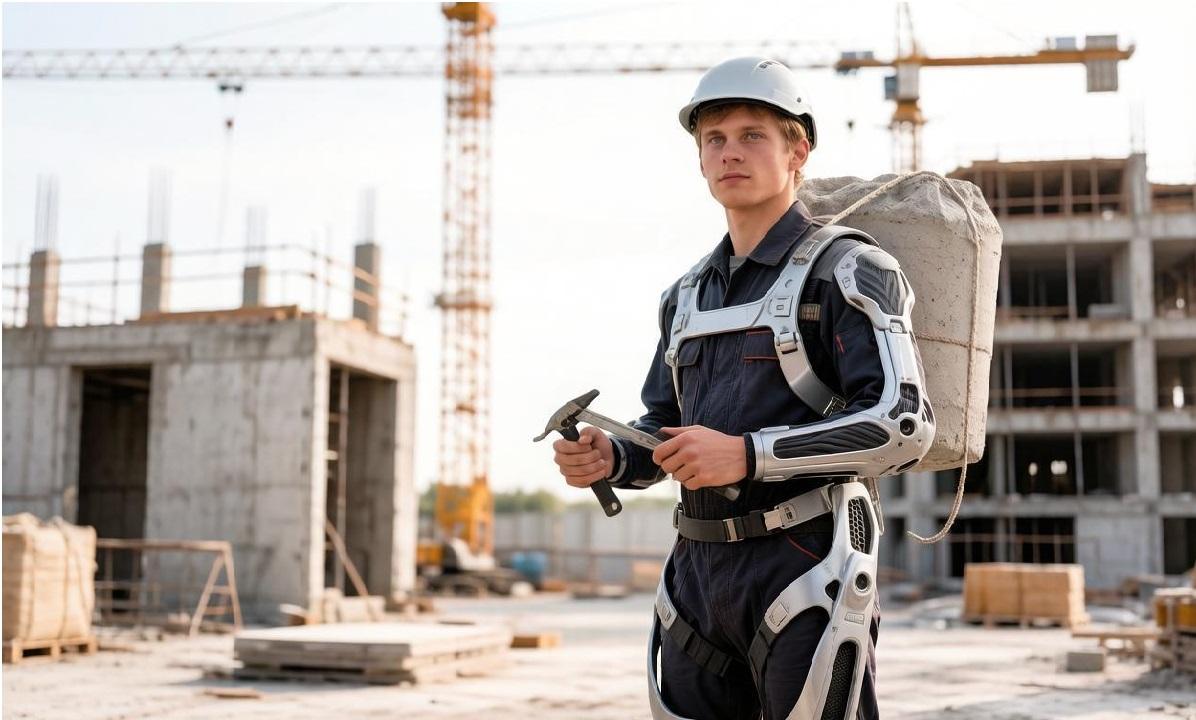
Thanks to the use of carbon fiber and aluminum-lithium alloys, the device weighs only 8–12 kg. It can be adjusted for any operator without tools in about 10 minutes.
The design is intended for working with heavy loads: the exoskeleton's lifting capacity reaches 60 kg, while the person feels only a fraction of the load. The development is planned for use in lifting and moving building structures, loading and unloading operations, and also to assist painters during finishing work.
Alexander Agarkov, Head of the Department of Mechanization, Automation, and Robotization of Construction at NIU MGSU, said that the development is based on a new kinematic scheme. It combines the person, exoskeleton, load, and support into a single system, thereby reducing the load not only on the spine but also on the hip, knee, and ankle joints.
Moreover, the device does not require motors or batteries. The design uses only elastic elements – torsion bars and springs – which accumulate energy during movement and return it. The project is being created within the framework of the national project "Means of Production and Automation." The development has already passed laboratory tests of prototypes. According to calculations by the Russian Ministry of Construction, the use of exoskeletons in construction can increase labor productivity by 15–17%.
Read more on the topic:
Never miss our newsAdd this site to your preferred sources to see us more oftenAdd on Google