Russian scientists have developed a new control system for a rehabilitation exoskeleton that helps restore hands and the shoulder girdle after severe injuries. The main feature of the development is patient safety. The algorithm was created at Tambov State Technical University (TSTU).
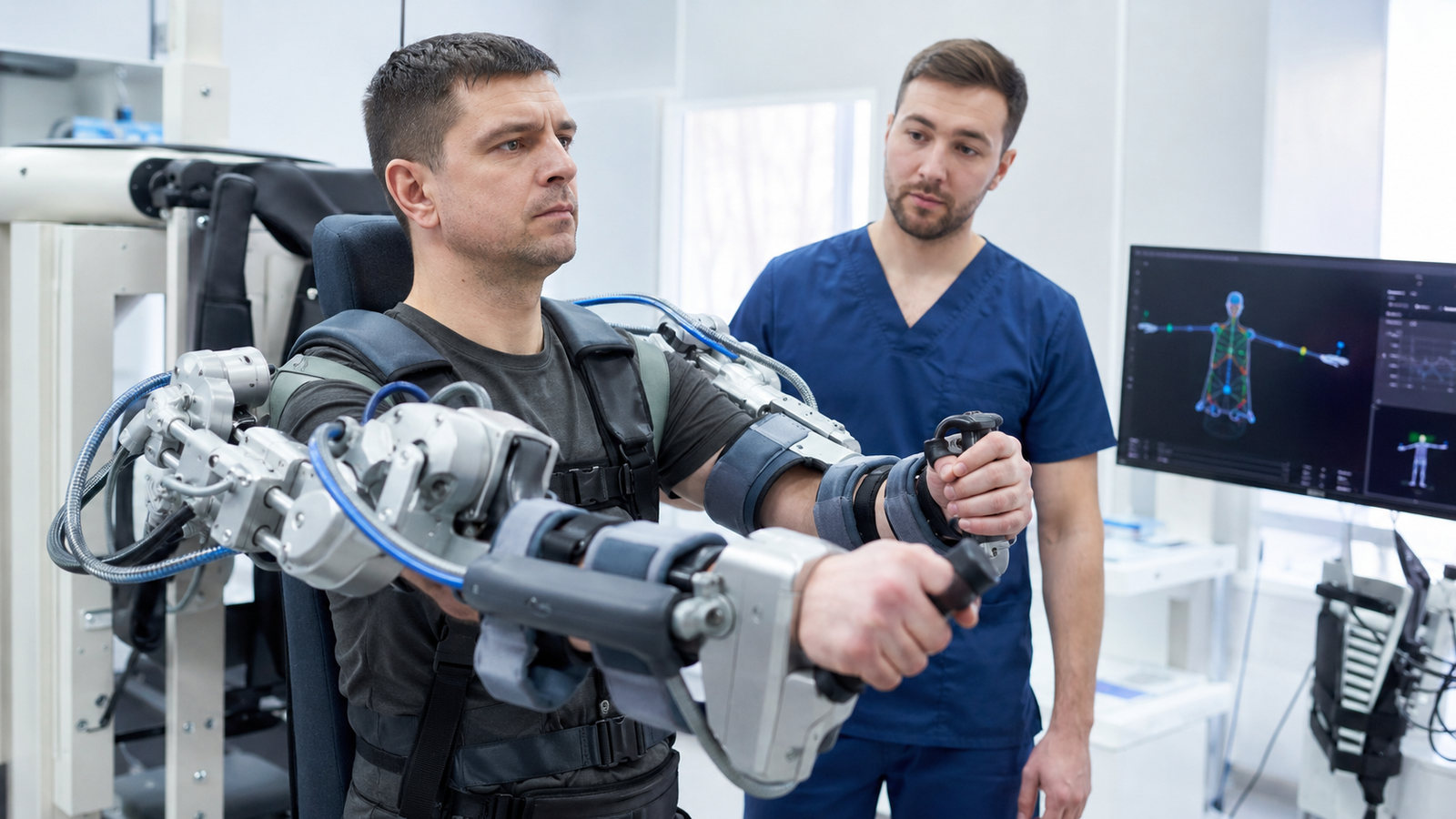
This refers to a hybrid control algorithm for a pneumatic upper limb exoskeleton. The university emphasizes that it 100% eliminates the risk of patient injury during device operation.
The new technology complements the previously presented rehabilitation complex "NeuroStep". It uses contactless AI tracking for gait training and recovery after severe injuries and leg amputations. Now, a development for hands and the shoulder girdle is being added to it.
Together, these solutions should form a unified domestic high-tech ecosystem for the rehabilitation of combat veterans.
The main difficulty with active exoskeletons is that parts of the mechanism can intersect in space. If the drive malfunctions, it can be dangerous for the patient. Therefore, TSTU researchers focused specifically on proactively eliminating dangerous device positions.
To do this, they combined complex mathematical modeling with high-performance 3D simulation. The system analyzed over 758 million spatial positions of the exoskeleton. After that, the algorithm filtered out potentially dangerous options and formed a safe state matrix.
Another important element is the pneumatic drive. It acts as a natural physical damper: it helps safely absorb sudden muscle spasms that may occur in the patient during recovery.
The software for the complexes is created by a team of engineers and student developers from TSTU. The university emphasizes that this is important for technological sovereignty and allows for faster adaptation of equipment to the needs of specific hospitals.
Read more on the topic:
- A new and unique robot control system using thoughts has been developed in Nizhny Novgorod
- Up to 15 Degrees of Freedom: Prototype Exoskeleton for Post-Stroke Rehabilitation Developed at Siberian State Medical University
- Carbon fiber cup instead of metal: PNRPU scientists calculated under what loads a composite prosthesis will not break
Never miss our newsAdd this site to your preferred sources to see us more oftenAdd on Google