Translated with AI from the Russian original.
A cane helps a blind person find obstacles below, and hearing helps them notice cars, people, and other moving objects. But there is a dangerous zone that is easy to miss: low-hanging branches, road signs, entrance canopies, and other stationary objects at head and shoulder level. It is precisely for this "blind spot" that Alexander Polyakov, a tenth-grader from Moscow school No. 2120, together with his scientific advisor Roman Perepechaev, developed a new device – a head bandage with an ultrasonic echolocator.
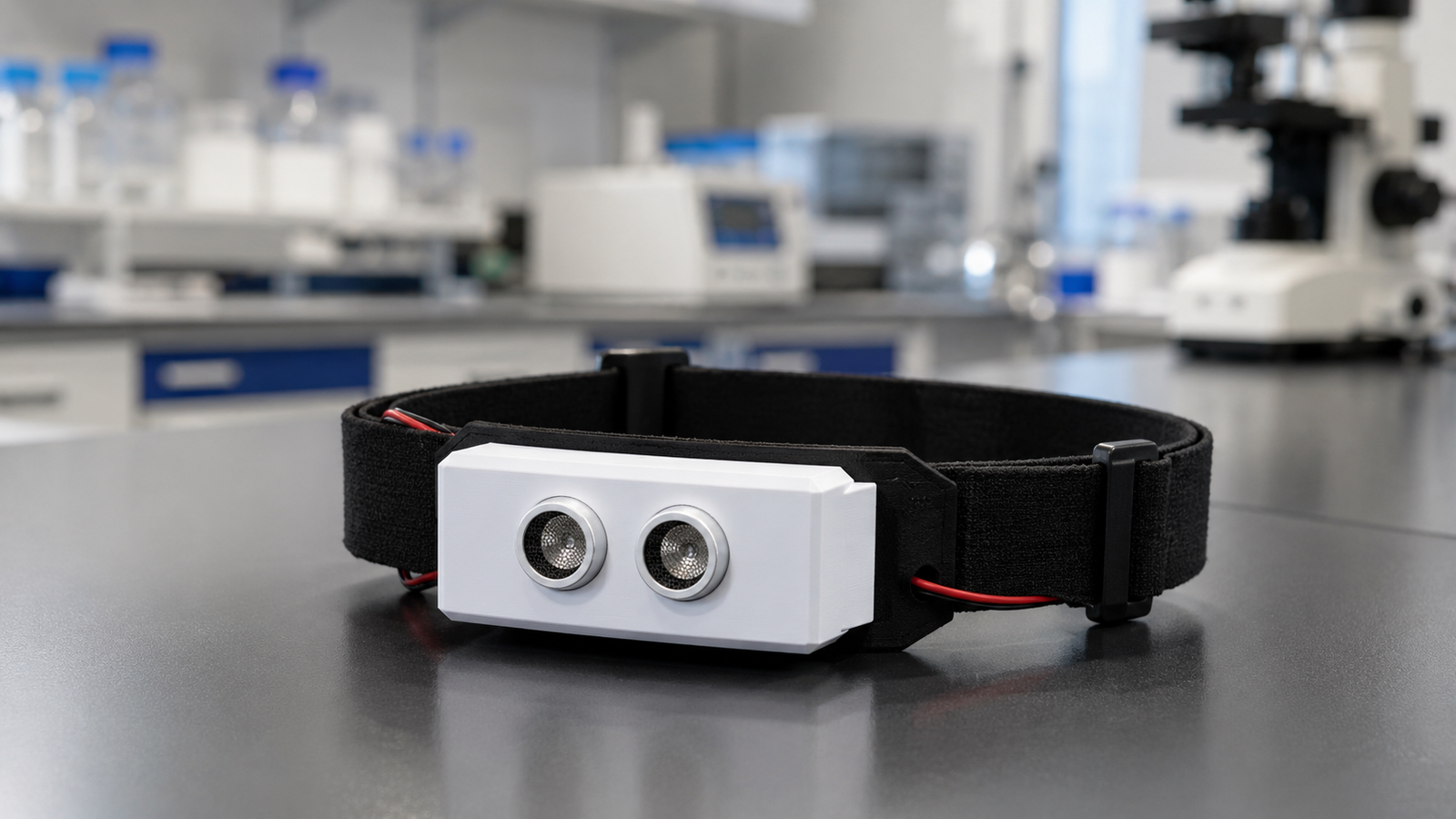
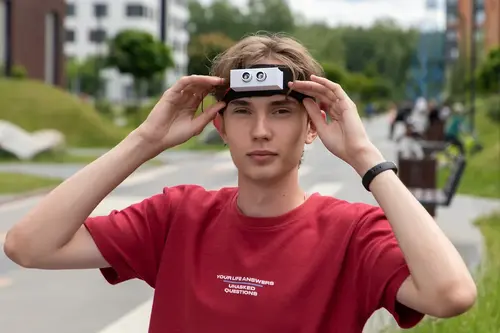
The sensor scans the space ahead, and the microcontroller translates the distance to the obstacle into vibration. The closer the object, the stronger the signal. The developer chose vibration precisely because it does not drown out hearing: the person continues to hear cars, voices, and other important street sounds.
The vibration gradually increases and is felt on the head, so it is difficult to confuse it with a phone or watch signal. The device also has an accelerometer: in the absence of movement, it puts the system into sleep mode to save battery.
The ultrasonic sensor does not distinguish what is ahead – a branch, a wall, or a person; it simply measures the distance to the obstacle. During tests, approximately two or three out of ten activations turned out to be false, but the author considers this acceptable for a laboratory prototype.
Ahead are tests with the participation of blind people, collection of feedback, refinement of ergonomics, and preparation for larger-scale field experiments. The developer plans to redesign the casing and add straps so that the device fits more snugly on the heads of different users. The main metric for him remains the reduction of the risk of injuries and head impacts.
Read more on the topic:
Never miss our newsAdd this site to your preferred sources to see us more oftenAdd on Google

















