Translated with AI from the Russian original.
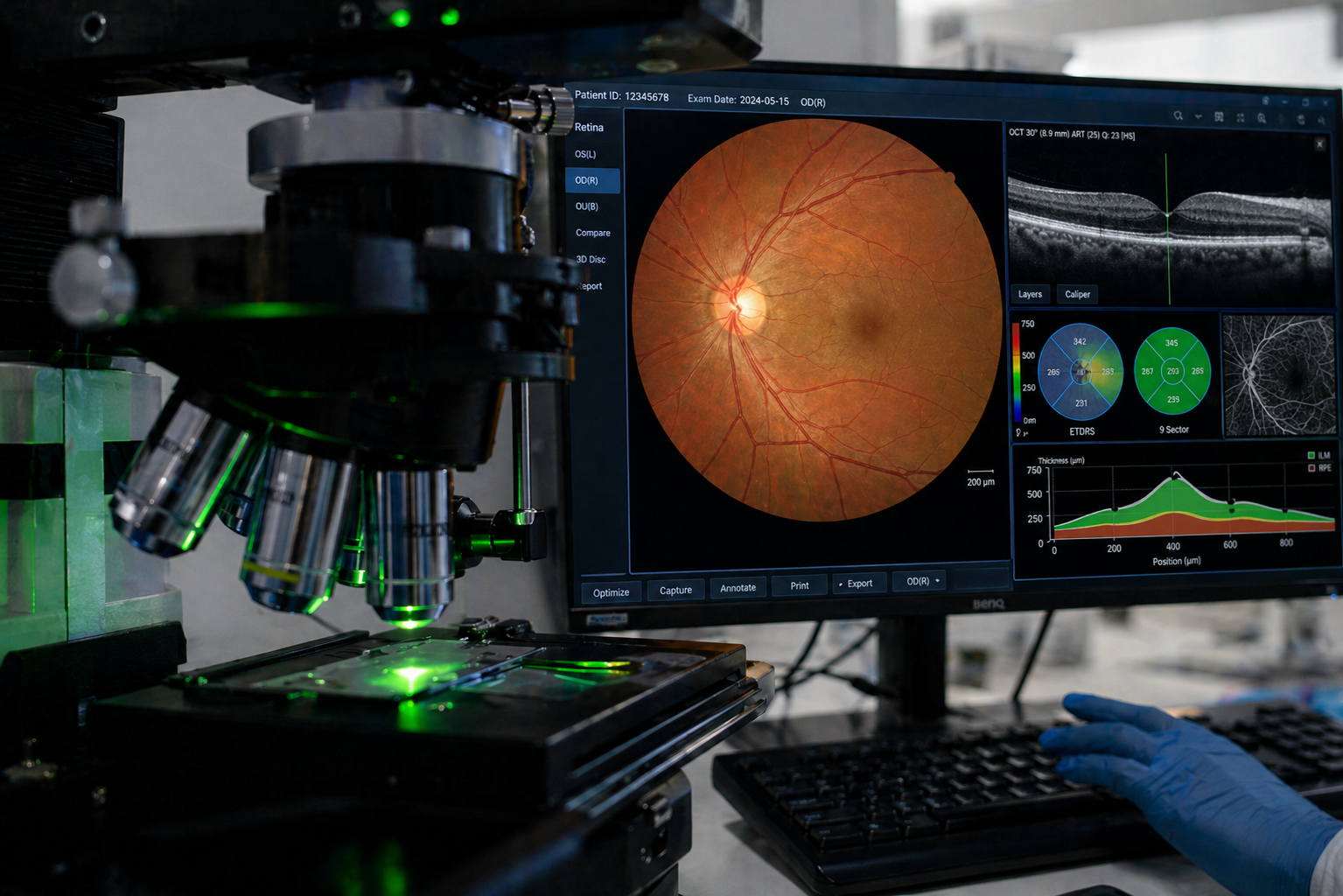
Lomonosov Moscow State University (MSU) has developed a new method for assessing the condition of the retina. Scientists detect signs of age-related degeneration by its luminescence using a laser. The method allows analyzing "aging pigments" that accumulate in the visual system.
What problem are scientists from MSU and RAS fighting?
Age-related macular degeneration (AMD) is one of the most common vision diseases. It occurs in approximately one in ten people over 60 and one in five over 70. The main danger of the disease is that in its early stages it proceeds almost without symptoms and actively manifests itself only when retinal damage becomes irreversible.
The disease is based on the accumulation of lipofuscin – the so-called "aging pigment". It accumulates in the cells of the retinal pigment epithelium due to impaired utilization processes. In essence, it is cellular "waste" that becomes dangerous over time.
Under the influence of light, lipofuscin components oxidize and form reactive oxygen species. These compounds damage pigment epithelial cells, disrupt their function, and ultimately lead to their death. This is followed by the destruction of photoreceptors – rods and cones, which are responsible for vision.
The peculiarity of the new method of combating vision degeneration – "illumination" of the retina
Existing diagnostic methods do not allow determining the composition of lipofuscin and understanding how toxic it is to the cell. However, the new approach solves this problem: scientists proposed using picosecond-resolved laser spectroscopy.
The method is based on the fact that scientists use a laser to "illuminate" the retina and analyze its faint luminescence. This luminescence arises due to the accumulation of lipofuscin. By how it glows (including the duration and characteristics of the signal), its composition and toxicity can be determined, which means that early signs of age-related retinal degeneration can be identified and the degree of risk of cell damage can be assessed.
As Svetlana Sidorenko, a researcher at MSU, explained, this method can be used not only for diagnosis, but also to check how effectively the treatment works.
For example, it helps to monitor retinal protection. One of the approaches currently being developed by scientists is to replenish natural substances that protect the eye (lutein and zeaxanthin) using a special protein that delivers them directly to the retina.
The development team included employees of the Faculty of Biology of MSU, the A. N. Belozersky Research Institute of Physico-Chemical Biology, and the M. M. Shemyakin and Yu. A. Ovchinnikov Institute of Bioorganic Chemistry of the RAS.
The results of the study, carried out within the framework of the MSU Interdisciplinary Scientific and Educational School "Molecular Technologies of Living Systems and Synthetic Biology", were published in The Journal of Physical Chemistry B.
Read more on the topic:
Never miss our newsAdd this site to your preferred sources to see us more oftenAdd on Google

















